Tuesday, August 31, 2010

The (second) Uplift Trilogy: Review


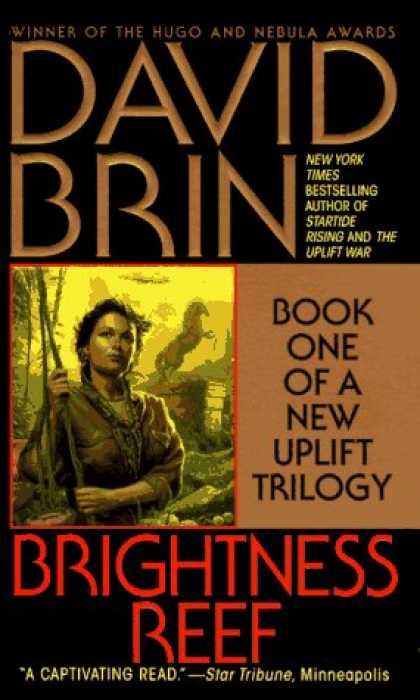
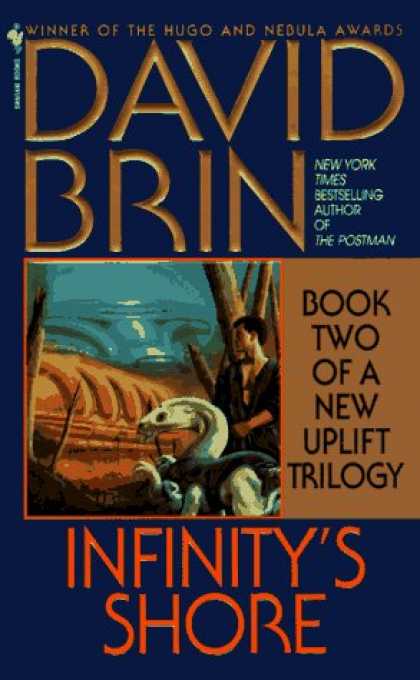
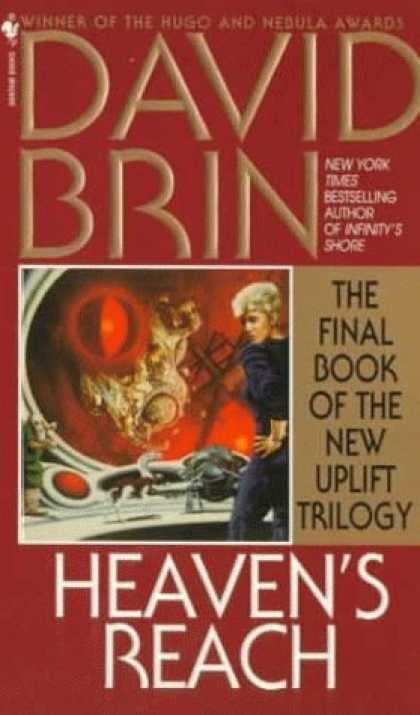
Alright, so you may have surmised from my last post that I really enjoyed reading Brin's second Uplift trilogy.  Brightness Reef (1995), Infinity's Shore (1996) and Heaven's Reach (1998) contain so many thought-provoking ideas wrapped up in an exciting plot, how could I not rate it highly?  [This is yet another example of how I need half steps in my rating system--I would give it 4.5 hamsters if I had a suitable graphic!]

First off--do you need to have read the previous Uplift novels to make sense of the story in this series?  The answer is definitely not as the essential details (particularly the events of Startide Rising [1983]) are revealed as remembrances of the characters.  But, on the other hand,  it certainly couldn't hurt.  I read the first Uplift books many years ago and had only a vague remembrance of the plot, and I did just fine.  The better question is why haven't you read them yet anyway?

The story opens on Jijo, a backwoods planet that has been declared fallow by the galactic Institute of Migration so that its ecosystem might have time to recover after use by its former inhabitants.  Here we find a society forged by members of six species (of which humans are one) who have independently colonized the planet for different reasons but with the same intent--to drop out of galactic society.  Unauthorized use of the planet is, of course, highly illegal in the eyes of galactic law.  As a result, the colonists have forsaken galactic technology and strive to leave no mark upon Jijo that might give them away from space. These circumstances have led to the development of a uniquely Jijoan religion based around the hope of regressing to a pre-sentient state by fostering a more primitive lifestyle.  If this state can be achieved, perhaps the Jijoans will be discovered by a new patron species and uplifted to a more perfect state.  This concept permeates every aspect of Jijoan culture.

Despite a somewhat fractious pass, the sooner species have forged peaceful bonds, united in their striving for redemption in the form of devolution.  This fairly idyllic life is shattered when a starship descends to the planet surface in the middle of an annual gathering of the six species.  It is soon discovered that these newcomers are not agents of the galactic government, but are, instead, criminals looking to raid fallow planets for species that may be ready for the uplift process.  This revelation sparks a fierce debate among different Jijoan factions, and the first half of the trilogy deals with the upheaval caused by the conflict.

Unbeknownst to just about everyone on the planet, two other spaceships have also arrived on Jijo.  The Streaker, from Earth and crewed by uplifted dolphins, has been on the run from most of the galaxy for several years following a spectacular discovery with implications for the identity of the revered Progenitors (detailed in Startide Rising).  The second ship, from the feared Jophur clan, has arrived in pursuit of the Streaker.  Streaker's predicament slowly transitions to the fore of the plot and drives the action for the remainder of series when a group of Jijoans are caught up in the trouble and forced to leave the planet.  It turns out that the Streaker has a pivotal role to play in deciding the fate of not only humankind but that of galactic civilization at large!

The characterization of the dolphins aboard Streaker is definitely one of the high points of the novels.  They are imbued with just the right blend of playfulness and intelligence.  This often comes across in the haiku verse (named trinary) that the neofins use to communicate with one another aboard the Streaker.  Also enjoyable was our first experience with hydrogen breathers, the second major order of life in the galaxy.  The idea of a wholly separate division of life above the species level really grabbed me when I read the first Uplift books, and I was hoping it would get explored further in this trilogy!

I'm not sure that I've done the novels justice above, but I hope it comes across that I thoroughly enjoyed this trilogy for both its bold ideas and wonderful writing.  This will teach me to combine three reviews into one next time I read a trilogy...it turns out to be harder than I thought!

Thursday, August 26, 2010

The (second) Uplift Trilogy: Introduction


No, I haven't abandoned posting to the blog!  After nearly a month, I'm back to review not one but three novels: David Brin's "new" or "second" or whatever-you-want-to-call-it Uplift trilogy. Unlike the previous three  novels set in the Uplift universe, Brightness Reef (1995), Infinity's Shore (1996) and Heaven's Reach (1998) share a continuous plot from book to book.  For this reason, after finishing the first novel, I decided to review the series as a whole.  To make this a less monumental task, I'm going to break the review into two parts:  an introduction to the Uplift universe and a review of the three novels themselves.

Are you looking for a literary universe with mind bogglingly cool ideas?  Well, David Brin has more of them than you can shake a stick at in his Uplift novels!  I really don't even know where to begin.  The essential feature of his universe revolves around the idea that more advanced starfaring civilizations "uplift" presapient species by directing the final stages of their evolution into an intelligent species.  This is, of course, done through genetic and social manipulation over the course of many years.  Once uplifted, the species is considered a member of galactic civilization in its own right but is indebted to and remains part of the "clan" of their patrons.

It is commonly believed that a mysterious race known as The Progenitors instituted the Uplift process up to a billion years ago before disappearing without a trace.  This has led to the development of a number of different belief systems based around the fate of the Progenitors, and, indeed, the ultimate fate of all galactic species.  In galactic society, the purpose and fate of individuals is rarely considered important (or even considered at all).

Humans are relative newcomers onto the galactic scene, having made contact a few hundred years prior to most of the events in the Uplift novels.  They are one of the rare species (known as wolflings) who have managed to bootstrap themselves into the stars without the help of a patron species.  The lack of patrons to guide and protect humans as they establish themselves puts them in a very rough spot among the rigid caste system that dominates every aspect of galactic life.   Luckily, humans had already began the process of uplifting chimpanzees and bottlenose dolphins before making contact with galactic civilization.  This gives them a little more cred than the few other wolfling species have had in the past.

In the Uplift universe, life in the linked galaxies is divided into several orders of life.  Not only are there oxygen breathing species, but also those that utilize hydrogen to sustain life (I won't comment on the biological feasibility of this concept).  Suffice it to say that the two groups don't get along well.  The Institute of Migration, an arm of galactic bureaucracy, coordinates oxy interactions with hydros, even going so far as ceding them whole swathes of galaxies to avoid conflict.  While hydros were tangentially mentioned in the first three Uplift novels, they play a far larger role in the second series of novels.  In addition to the two organic forms of life, there are a number of other orders that oxygen species have so far had limited interactions with:  machine, quantum, memetic, etc.

The age of galactic civilization is staggering, with at least a billion years of history going back to the Progenitors.  Starfaring civilizations have, therefore, been gathering and refining their knowledge for many hundreds of millions of years, collecting it in a repository known as the Galactic Library.  This knowledge is communicated using a set of standardized languages that have been refined over the eons to transmit information as efficiently as possible between species with vastly different auditory, visual, and vocal organs.  The languages vary from a series of pops and clicks that most any species produce (with tools if necessary) to higher level languages more akin to what we humans would call "talking."  Because of these highly ordered information conventions, most species take the opinion that "everything that is done has been done before," thereby reinforcing the conservative nature of society as a whole.  Needless to say, this conflicts with indomitable human nature and becomes one of the central themes of the Uplift novels.

Are you getting the drift here?  Brin has created a rich and vibrant universe!  I could list ten other provocative ideas he describes without even trying.  The Uplift novels have a bit of everything--hard biology and physics with a large dose of sociology, anthropology (or species-pology?) and psychology thrown in.  I highly recommend all six Uplift novels--they are both well written and thought-provoking and rank among the best that science fiction has to offer!

[Next time:  an actual review of the second Uplift trilogy.]

Thursday, July 22, 2010

A Morbid Taste for Bones


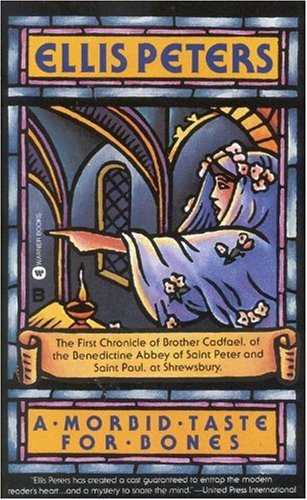
A Morbid Taste For Bones (1977) is the first in the Brother Cadfael series of mystery novels set in 12th century England by Ellis Peters (of which there are 21 books).  I have my mom to thank for introducing me to Brother Cadfael's adventures many years ago.  I'd like to reread m .  Note:  I listened to this as an audiobook.

The main character, the Welshman Brother Cadfael, is an unusual example of a Benedictine monk who lives in the Shropshire village of Shrewsbury.  I say unusual because he has come to his monks' habit late in life after having spent many years in the Holy Land as a Crusader in his younger years.  His rich life experiences give him an eye for seeing people and events in a different light than most of his cloistered brothers.

As the novel opens, Colambanus, one of Cadfael's brothers is overcome at Mass by a fit of religious fervor and falls into a coma.  A brother standing vigil in the night over the stricken brother is visited by a mysterious personage who instructs him to bring Columbanus to the Well of St. Winefride in Northern Wales.  By no coincidence, St. Winefride has been shortlisted as a saint whose relics the Abbey (or more specifically, the overbearing Prior Robert) has an interest in acquiring.  Getting a hold of a saint's relics was a big deal in medieval times, when housing such a religious relic would guarantee a constant stream of pilgrims (and revenue) for a church .

Columbanus is miraculously cured at the well and insists St. Winefride herself appeared to him and expressed a desire to be moved to a place more hospitable to pilgrims.  The majority of the book revolves around a journey undertaken by the monks to translate her remains from the village of Gwytherin to the Abbey of Saint Peter and Saint Paul in Shrewsbury.

Needless to say, the residents of Gwytherin are none to happy with the sudden interest taken in their Welsh patroness by English monks.  Despite having the permission and authority of both the church and local lord, the village is reluctant to allow the brothers to remove St. Winefride's body.  At a village-wide meeting, an influential landowner, Rhisiart, clashes with Prior Robert and cements the village's intention to deny the monks their prize.  The following day, Rhisiart is found foully murdered by an arrow through the chest.  Being Welsh himself, Cadfael feels especially close to the involved parties, and he undertakes a full investigation of Rhisiart's murder.  Using his uncanny ability to read people, Brother Cadfael unravels the mystery after several twists and turns.

Ah - but does St. Winefride ever make it to Shrewsbury?  You'll have to read to find out!

I thoroughly enjoyed the novel.  Brother Cadfael's character is delightfully written.  He is both irreverent and witty at times -two traits one does not usually associate with a medieval monk.  He's the kind of guy you'd love to sit down and have a drink with.  I look forward reading about his further adventures!

Tuesday, June 29, 2010

A Separate Peace


I ran across A Separate Peace (1960) on our shelf when moving some of our book collection around.  It turns out to be a fairly popular selection for high school English classes, but somehow I missed the bus on that one.  At any rate, the description sounded fairly interesting as I'm always one to enjoy a good boys' school drama a la Dead Poets Society.

The novel, a fairly quick read, is the story of two friends at a boarding school in New England during World War 2.  The two main characters, Gene and Phineas, are a study in opposites: Gene is the more introverted, studious type, while Phineas is a gregarious athlete.  The two have been drawn to one another, and as the novel opens are enjoying the carefree days of the summer session at the Devon School.

Toward the end of summer an event occurs that will change both of their lives forever.  Finny conceives of a club whose members must prove themselves by jumping from a tree into the river, a fairly dangerous affair as the tree is set back from the banks of the river.  As the co-leaders, Gene and Finny contrive to impress everyone by jumping from the tree in tandem.  While making their way out on a limb to do this, Gene inexplicably bounces the branch, causing Finny to fall onto the ground below and badly break his leg.  The remainder of the novel is really a character study of Gene and the ugly truths he discovers about himself in the wake of the tree incident.

It becomes clear that Gene is extremely jealous of Finny's very natural good-natured approach to life.  Gene convinces himself that Finny has plotted to bring about his academic downfall by goading him into spending time away from his studies on various pursuits.  This jealousy eventually manifests itself physically in his treacherous act on the tree over the river.  Gene's character is starkly contrasted by Phineas, who is an innately good individual, even going so far as to deny Gene's act when Gene visits him to confess.  Another traumatic event forces Gene to come to terms with his character, and we are left with the hope that he will try to grow from his experiences with Phineas.

I enjoyed the overall message of the novel, but it was a fairly dull read.  Since I have chosen to base my hamster scale mostly on my enjoyment of the reading experience, I give it only three hamsters.  This is not to say I don't recommend it, but a thrilling read it is not!

Monday, June 28, 2010

The October Horse


The October Horse (2002) is the sixth book in the 'Master of Rome' series that chronicles the people and events surrounding the downfall of the Roman Republic.  True to its predecessors, this is a massive tome (1120 pages) that, while remaining fiction, is firmly rooted in primary historical sources.

The book is rather aptly named after a custom held after a particular chariot race held each year in Rome on the Ides of October.  The strongest horse from the winning chariot team was sacrificed to the gods.  Afterwards, its head was flung into a crowd consisting of two teams of plebeians who fought for its control.  You don't have to be a classical scholar to realize that the October Horse is a thinly veiled allusion to Julius Caesar.

The book opens in 48 BC just after Pompey the Great has been treacherously murdered in Alexandria at the hands of the ruling Ptolemy.  Julius Caesar lands in Alexandria and, upon discovering the circumstances of Pompey's death, immediately sides with Cleopatra who is embroiled in a civil war against her brother Ptolemy.  After a short campaign, not only does Cleopatra solidify her rule of Egypt, but she also falls desperately in love with Caesar and will eventually bear him a son, Caesarion.

Of course the crowning moment of the entire series is the fateful event that took place in Rome on the Ides of March in 44 BC.  McCullough does a fantastic job of building the conspiracy against Caesar that arises first from the grumbles of his discontented former legates.  The pacing of events in this section of the novel is truly fantastic, and McCullough keeps the suspense taut until the final act of Caesar's life is played out.  I can only imagine it must have been a difficult scene for her to write, as she has practically idolized Caesar from his earliest appearance in the series.

At this point, I should mention that I strongly feel that The October Horse should have been split into two separate novels.  The death of Julius Caesar, without doubt the central character of the entire 'Masters of Rome' series, would have been a natural place to stop action.  After the assassination, I wanted to take a break and come to grips with Caesar's death, and indeed that of the Republic, but felt I never really got the chance.

Instead, the remainder of the novel (we're talking hundreds of pages here) are left to deal with wrangling between Mark Antony and Octavian (Caesar's adopted son) for the control of Rome.  We find Octavian to have many of the same outstanding qualities of Julius Caesar but also lacking his intense sense of fairness and scruples.  Overall, Octavian comes off as a quite unlikable character in my estimation, although I suppose you don't get to be the emperor of Rome being nice!

Despite a few small quibbles, I was wholly satisfied with the novel, which was originally intended to end the 'Masters of Rome' series at the Battle of Phillipi, the point at which McCullough considers the Roman Republic to have died for all time.  Luckily for us, she relented and wrote a seventh book to carry the characters through to Actium, where Mark Antony is defeated decisively and Octavian ascends to the throne as Augustus Caesar.  Rest assured I'll be reviewing this last novel sometime in the near future!