Showing posts with label books i've read. Show all posts

Friday, August 8, 2014

Forty Days at Kamas

I am alive!  It has been almost two years since I updated the blog.  What can I say?  A lot has been going on (and will continue to be in the foreseeable future with a brand new daughter on the way!).  I'm going to try my darndest to get back to semi-regular blog updates.

For anyone interested in seeing what I've been up to reading-wise, take a look at my Goodreads profile.  That's actually part of the problem--Goodreads requires so much less activation energy for keeping track of my reading than writing blog posts!  The best book I've read in my absence is probably Crime and Punishment by Fyodor Dostoyevsky (1866), but I don't have the wherewithal to tackle a review of it other than to say read it if you haven't already done so. 

My latest read was an Amazon Kindle freebie entitled Forty Days at Kamas by Preston Fleming (2013). The novel has an intriguing dystopian premise (I'm a sucker for dystopias--I'll even admit to having read Divergent during my hiatus from the blog [rating: 1 hamster...don't get me started]).  It follows events in a prison camp for political prisoners in an imagined totalitarian America of 2024. It is told through the eyes of Paul Wagner, a former businessman, who lands as an inmate at the camp after a trumped up political accusation tears him from his family.  After a series of brutal incidents, the mood in the camp begins to simmer and eventually boils over into a rather ill-advised open rebellion.

The prose itself was well written (always a major concern with self-published ebooks!), however I couldn't get past several hangups in the world-building and plot:

1) I desperately wanted--no, needed--to know more about the events (referred to, rather unoriginally, as 'the Events') that bring about the dystopian United States as presented in the novel. It is implausible to suggest that the USA could devolve from the constitutional republic we currently enjoy to the brutal totalitarian regime described in the novel in the short space of 10-ish years. Such a bold brushstroke demands (at least in my view) more of an explanation to the reader.

2) There wasn't much of anything to distinguish the totalitarian society as distinctly American--it could just as easily have been a Jamaican or Brazilian prison camp as far as I was concerned. Instead of dismantling the abandoned environs of Park City, Utah, they could have been picking bananas on a tropical plantation without impacting the plot in the slightest. 

3) Why on earth did the Security people spend so much time and energy negotiating with the prisoners, making promises to them, planting spies among them, etc. during the revolt? The brutal treatment and indiscriminate killing of prisoners that pervaded life in the camp convinced me early on that there was nothing to stop the authorities from wiping the prison camp off the face of the map without a second thought (SPOILER ALERT:  as, indeed, happens). 

I'm probably intrigued enough to check out the second book of the series, if only to see if any of my questions are addressed, but let's just say it won't be flying to the top of my reading list.  

Monday, August 27, 2012

Rubicon: The Last Years of the Roman Republic


Rubicon: The Last Years of the Roman Republic (2003) is a non-fiction book covering the events in Rome of the first century B.C., and is a wonderful introduction to the fall of the Republic.  If you don’t normally read non-fiction, don’t let the fact that it is put you off.  It is a fantastically written book--the prose keeps the complex narrative moving while always injecting bits of wit or personal accounts from ancient sources.  This is no dry history book—it reads more like a novel.
 
Holland's central thesis asserts that the intense personal ambition instilled in Romans from birth led to their downfall.  Can you imagine growing up in a house with an entire room devoted solely to the accomplishments of your ancestors?  With their wax effigies are arranged so that they stare down at you as if to pass judgment on your worth?  If it sounds serious, it’s because it was deadly serious to the Romans.  Rising to the highest levels of government was the pinnacle to which all Roman males aspired.  Enhancing the might of the Roman Republic was to enhance your own personal prestige and dignity.  To a large measure, this intensity powered the rise of Rome from city to regional power, and with the defeat of Carthage, to the undisputed master of the world.

The problems set in when men of such incredible ambition came up against the constraints of the Roman constitution (more a loose collection of laws and customs than any single entity).  A long succession of Romans began to fiddle with the system, looking for ways to exploit it to their own betterment.  In short, somewhere along the way, men ceased to fight for the interests of the Republic and, instead, sought personal power.  This culminated in the final generation of the Republic with men like Sulla and Caesar who finally brought down the house of cards.

I say that Rubicon is an "introduction" because Holland focuses so heavily on the role of personal ambition in the Republic's downfall at the expense of other broader issues.  Judging by his obvious command of the history, I'm sure this was done on purpose, but I worry that those not as familiar with the time period might miss the importance of these crises.  Given the parallels between the class structure of Roman society and that of modern America, these kinds of issues and the ways in which they are dealt with are of particular interest.
My major gripe about Holland’s approach is that he enters the story a bit too late to give a good accounting of some of these issues, picking up the narrative in force with Sulla’s exploits in the 90s B.C.  Most folks cite the tribuneship of Tiberius Gracchus (133 B.C.) as the key event that instigated the century-long series of crises that eventually led to the fall.  Holland glosses over both the Gracchi in the opening pages and devotes little time to discussing the hallmark of their campaign—land reform.  Likewise, the career of Marius is relegated largely to the sideline.  He, more than any other, was most responsible for bringing about the shift in loyalty of armies from the Republic to the general in command of the force! 

In spite of my few minor quibbles, Rubicon is the best non-fiction book I’ve read about the fall of the Roman Republic.  The writing is truly exceptional!  Folks looking to get fully immersed in this period should also check out Colleen McCullough’s ‘Masters of Rome’ series.  While fiction, it is firmly based in primary sources and really brings the personalities of the great men to life.  

Friday, June 1, 2012

The Maze Runner


After reading The Hunger Games and enjoying it, I did what a lot of folks did and scoured the internet looking for books of a similar vein.  One that kept coming up was The Maze Runner (2009), the first novel by James Dashner.  I admit to feeling bad about comparing the two novels in the first sentence of my review, but it is almost unavoidable given their plots and intended audience.  To be fair, Dashner wrote The Maze Runner nearly two years before The Hunger Games was published, so the rampant cries that his novel is a blatant attempt to capitalize on the success of THG are misleading.

At any rate, The Maze Runner does fall into the young adult dystopian genre that seems to have saturated the book market in recent years.  The novel has an entirely intriguing premise:  the main character, Thomas, wakes up in a strange glade inhabited by a group of other teenage boys.  Like everyone else in the glade, Thomas has no clue how he got here.  This glade actually lies in the center of an enormous, constantly changing maze seemingly without an exit.  To top it off, every night a bunch of horrible creatures appear, bringing certain death to anyone not in the safety of the glade by sunset.  Thomas is immediately drawn to the maze runners, the boys which daily risk life and limb to venture into the maze in an attempt to map it and reach an exit.  Within days, a girl also arrives in the glade--needless to say this throws everyone into a tizzy because she is the first girl ever to arrive in the glade.  It soon becomes clear that both Thomas and Teresa have a special role to play in the life of the glade.

That's about all I can say without giving away anything, so I'll leave it at that.  While I found the plot to be quite engaging, the novel definitely stumbles when it comes to characterization.  I didn't ever connect with anyone in the novel due to Dashner's rather weak portrayals.  We are endlessly told about Thomas' emotional roller coaster--he is sad, scared, frustrated, confused, angry, but it all comes off as very shallow.  I never "feel" anything that he is experiencing, and every other character is treated similarly.  Given the great promise of the situation for high emotion and tension, this aspect of the writing was fairly disappointing.  So while the plot of The Maze Runner is on par with The Hunger Games, the quality of writing is not.

I think a much more apt comparison is with To Your Scattered Bodies Go (1971) by Jose Philip Farmer.  There is the same sense of awakening, wondrous setting, mysterious captors, and society building.  I don't think it is too much of a spoiler to say that there is ultimately the same journey to discover just what the heck is going on.  Again, in terms of writing, Dashner's novel pales in comparison to that of Farmer, but the two novels are quite similar in a general sense.

[some light spoilers here]
The end of the novel was also kind of a bummer.  Dashner's reveal a la Ender's Game was reaching a bit given the truly chaotic nature of the maze environment.  Furthermore, while there is some resolution to the situation at hand, the questions I most cared about were left completely hanging.  Yes, it was written with sequels in mind (like most every other young adult book these days), but dangling some clue as to the circumstances in the larger world would have been nice.
[/spoilers]

So, to sum up, I did enjoy the The Maze Runner from start to finish.  There is plenty of action and intrigue, and the writing for those parts is certainly up to snuff.  I do think I will read on in the series, but it won't be zooming to the top of my to-be-read pile.

Wednesday, May 9, 2012

The Wind Through the Keyhole


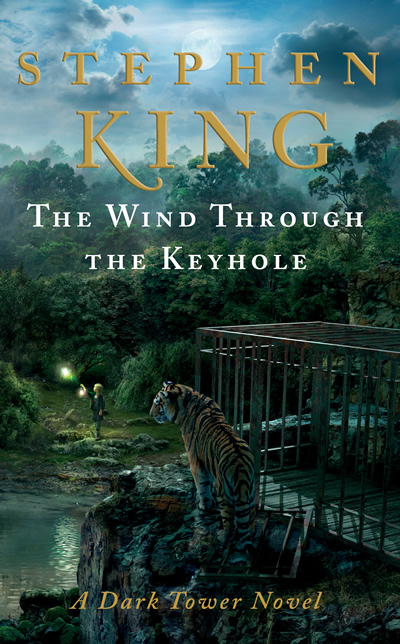
Fear not, dear reader!  I've once again been shaken out of silence.  This time to review a book hot off the press.  Stephen King's The Wind Through the Keyhole (2012) is what faithful fans of his Dark Tower series, myself included, have spent years waiting for.  No, not word of yet another TV or film adaptation that will ultimately be relegated to the clearing at the end of the path.  A new novel!

The Wind Through the Keyhole falls in between Wizard and Glass and The Wolves of the Calla, and so can be considered volume #4.5 of the Dark Tower.  During their journey away from the Emerald City, Roland and his ka-tet are forced to seek shelter from a once-in-a-generation storm known as the starkblast.  With all hell breaking loose outside, Roland settles down to tell a tale that harkens back to the year following his mother's death when gunslingers were still a force of law in Mid-World.

Roland is sent by his father to investigate a series of mysterious deaths in an outlying holding thought to be the work of a skin man, aka a shapeshifter. In the aftermath of a fresh attack by the skin man, he befriends a boy who has lost his entire family to the creature.  To calm him down and lend the boy strength, Roland relates a bedtime story told to him by his mother (who is oft on his mind in the wake of her death)--the legend of Tim Stoutheart and his dealings with Marten Broadcloak (aka the Man in Black, Randall Flagg), agent of the Crimson King and longtime nemesis of Roland himself.

The story of Tim Stoutheart and his coming of age provides the bulk of The Wind Through the Keyhole.  Through this narration, we get a portrait of the world before it has moved on (an aspect of the series which I find particularly interesting).  All the usual suspects that make the Dark Tower universe so compelling are there: cowboys, gunslingers, wizards, dragons, North Central Positronics, etc.  Tim's story is heartfelt and quite charming, adding a light interlude to relieve the otherwise on-the-whole gritty series.  Coming right off the events of Wizard and Glass, I think even the heartiest reader could use a bit of a breather!

While The Wind Through the Keyhole doesn't add heaps to the overall Dark Tower narrative, it nicely gives some further insight into Roland's character, particularly as it relates to the tragic circumstances of his mother's death.

It was really fabulous to spend some time with Roland and his ka-tet again, for I have rarely felt more of a connection to a group of characters.  There was the merest whisper of a hint that we might not have heard the last of Tim Stoutheart, so here's to hoping that King will treat us fans to more of the Dark Tower in the years to come!

A final tidbit:  one of the guardians of the Beams, who just happens to be a lion, is named Aslan!  How cool is that?

Wednesday, November 16, 2011

Long time, no entry...Part I

Well, unfortunately (or fortunately, depending on how you look at it), real life has once again caught up with me, and I haven't had time to properly review any books.  Never fear! I have been steadily reading away as usual, keeping track of everything over at Goodreads!  Since it is obvious that I stand no chance of ever catching up with my back log of books to review, I thought I'd go ahead and post a more succinct summary of my recent reads in a multi-part series.  So...without any further ado:

The Windup Girl by Paolo Bacigalupi (2009)
Co-winner of the 2010 Hugo Award (tied with The City & The City, previously reviewed by yours truly here).  The novel takes place in a near-future where energy sources have become severely depleted, forcing massive changes on society.  Food production is completely controlled by mega-corporations who engineer plants to suit their clients' needs.  An extremely good book with a lot of thought-provoking ideas about where humanity is heading if we continue on with our unsustainable rate of consumption. [5 hamsters]


The Brothers K by David James Duncan (1992)
This book follows the ups and downs of a midwestern family whose four sons come of age in the '50s and '60s.  Narrated by the youngest son, it focuses on the father's minor league baseball career and how his brothers deal very differently with the reality of war.  Laced throughout is some of the best writing about families that I've ever read--it really captures the love and dynamics of family in an unforgettable way. [4.5 hamsters]


The Hunger Games by Suzanne Collins (2008)
Is there anyone who doesn't know what The Hunger Games is about?  In a post-apocalyptic world, a central government holds the Hunger Games, where teenagers from different districts are pitted against one another in a televised battle from which there is only one survivor.  Fantastic premise, though the main plot is strongly reminiscent of Stephen King's The Long Walk (see my review here).  This is a heck of a good book--one of those that I simply couldn't read fast enough.  Highly, highly recommended.  [5 hamsters]


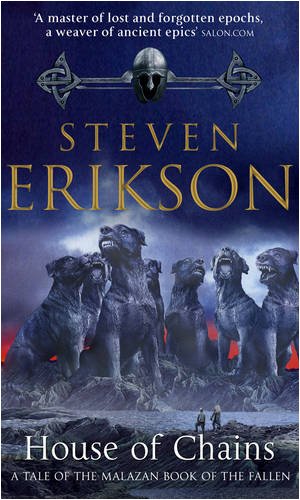
House of Chains by Stephen Erikson (2002)
This is the fourth book in the Malazan Book of the Fallen series (reviews of previous volumes here).  These novels continue to be somewhat convoluted and a challenge to piece together, but they also continue to capture my fascination.  House of Chains, a direct sequel to Deadhouse Gates, was a little slower moving than its predecessors, but carried the story forward nicely once everything got going.  [3.5 hamsters]


The Broken Wheel by David Wingrove (1990)
The second volume to the Chung Kuo series (first volume reviewed here).  No surprises in this one--nothing deep but a fast paced story in a well-realized future world.  Wingrove is in the process of reissuing an expanded 20-volume (if you can believe it) set of Chung Kuo books which I'm pretty excited about checking out in the future since it fills in some of the gaps in the original series.  [3.5 hamsters]


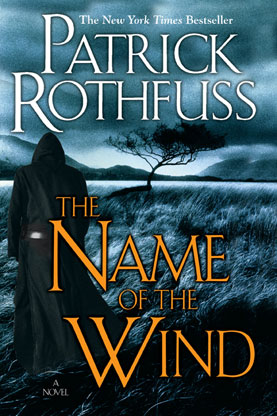
The Name of the Wind by Patrick Rothfuss (2007)
There was a lot of buzz around this novel on the nets, so I thought I'd check out Rothfuss's debut novel.  It is a really interesting book despite employing more than a few fantasy cliches.  The best description I can give it sells it short but here goes anyway: a mature version of Harry Potter.  Not quite fair, but the comparison is inevitable.  A well written book, it has one of the most logical, developed systems of magic of any novel I've come across.  There aren't people going around pointing wands at each other and saying cute phrases to wield magic; instead, a caster acts as more of a conduit for energies from the natural world.  Great stuff! [4.5 hamsters]

Stay tuned! More updates to come soon!

Monday, August 8, 2011

A Dance With Dragons


Never fear, dear reader, I've not forgotten about the blog but, rather, have been attending to more important things in real life (like earning a Ph.D.).  As it happens, it takes one of the biggest publishing events in geekdom to draw me out of my silence.  So, without further ado:

[Don't worry, I'm not going to include any real spoilers in the review.]

Unless you've been living under a rock lately, you probably know about George R.R. Martin's epic fantasy series, A Song of Ice and Fire (ASOIAF).  The HBO series based on the first novel in the series, A Game of Thrones, has been hugely successful and drawn people to ASOIAF that I otherwise would never have expected to show any interest.  My Goodreads and Facebook feeds have lit up in recent weeks with people talking about ASOIAF.  We're talking females who I went to high school here, for goodness sakes.  The powers of HBO are truly mind boggling.

Well, A Dance With Dragons is the fifth novel in ASOIAF.  It has been in the works for six, count 'em, SIX years.  Everyone (read:  geeks on the internet) was getting a bit worried about GRRM's ability to pull this one off after his long delay.  Also, he is not exactly a young man (or a particularly healthy-looking man for that matter), so this break was (is?) possibly threatening the completion of the series (let's not forget the tragic death of Robert Jordan).  Well, I'm happy to say that GRRM's latest novel is a solid effort; GRRM has lost none of his flair with the quill.

So:  Is there action? Adventure? Intrigue? Violence? Sex?  Fire-breathing dragons?  The answer to all these is, happily, YES!  Do we meet up with our favorite characters so cruelly abandoned in A Feast for Crows?  Yes!  Are there any events that are going to rock the foundations of ASOIAF?  I guess so (note the lack of enthusiasm; see below).

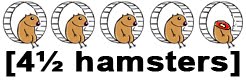
So what gives?  Why the 3.5 hamster rating?  While the novel has all these things and more, you will be forced to meander with each character across Westeros and the Free Cities many times over in between encounters of substance.  No form of transportation has been left out:  wagon, river boat, horse, sea galleon, and, most importantly, good ol' feet.  A Dance With Dragons cries out for a good editor--I could cut several hundred pages out of the book without raising a sweat and there would more than ample room to tell the same story.

This brings me to my biggest problem with the novel.  Simply put:  the novel spectacularly fails to push the main plot forward.  Characters are shuttled around the world, some things happen, but the threads of main plot are coming together so achingly slowly (or in several cases not at all), at this rate it is going to take at least 15 more books to reach some semblance of a conclusion to all this.

All this being said, the novel is a good read, certainly better than A Feast for Crows.  I look forward with great anticipation to the next book in the series, so I guess on that account, A Dance With Dragons is a spectacular success!

Monday, June 13, 2011

The Company


The Company (2002) is a huge door-stopper of a book (nearly 900 pages) that chronicles the Cold War as seen through the lens of the Central Intelligence Agency (CIA).  Mixing fact and fiction, the novel is a sweeping Clavell-style epic that begins with the end of World War 2 and continues through the collapse of the Soviet Union.

The Company (as the CIA is more colloquially known) revolves around a group of men who are recruited to join the newly minted agency after their graduation in the early 1950s.  They are soon thrown into the wild west that was post-war Europe and cut their teeth running agents and coordinating resistance within the Eastern bloc.  Soon the cohort becomes involved in several of the major covert operations that would come to characterize the West's struggle against the Soviet Union (e.g. the failed Bay of Pigs invasion).  These "on the ground" action sequences are some of the most compelling in the novel.  Littell portrays actual historic personalities alongside his fictional characters, and the two are blended together seamlessly.

Woven throughout the novel is a plot hatched by Starik, a sinister Soviet spymaster, to bring about the downfall of his glavny protivnik (principal adversary), America.  Taking the long view, Starik quietly embeds a double agent, SASHA, within the CIA and dangles tantalizing clues as to his identity in front of the Americans for decades in the hopes of creating a paralyzing climate of paranoia.  This plot arc, based on the career of the notorious spy-hunter James Jesus Angleton (featured prominently in The Company), provides continuity and links each major section of the novel together.  The climax of the novel comes as the fictional identity of SASHA is finally revealed (the real SASHA was never identified...if he even existed in the first place).

With a few notable exceptions, many of the fictional characters, though having well-developed personal stories, are fairly wooden.  The author also takes some liberties with his unflattering portrayal of real characters--Littell's Robert Kennedy is a rabid dog, and his Ronald Reagan a lost sheep.  Thankfully, these quibbles are fairly minor and the gripping plot quickly carries the reader past them.  Overall, The Company succeeds magnificently in its attempt to offer a panoramic look at the Cold War and the culture within the CIA during one of the more turbulent periods of American history.

Wednesday, May 25, 2011

Never Let Me Go


I'm the first to admit that I easily get swept up by the bandwagon when something big rolls around.  I take almost giddy delight in reading reviewer's quotes on the back of nearly every book I read.  So, when on the cover of Kazuo Ishiguro's Never Let Me Go (2005), Time magazine declares the book to be "the best novel of the decade," I go into it with fairly high expectations.  Moreover, Never Let Me Go is held up as a stirring expression of the moral disquietude that often comes hand-in-hand with advances in biomedical science, a field which is near and dear to my own heart.

The story itself revolves around a three children who are raised at Hailsham, a boarding school nestled in the English countryside.  Kathy H., the narrator of the novel, provides a window into Hailsham through her recollections of day-to-day life with her friends.  In the course of these vignettes, it becomes clear that Hailsham is no ordinary school.  The children, while seemingly well cared-for by their guardians, are not taught the skills necessary to lead an independent life and, arguably more damaging to them, lack any nurturing emotional connections save those they clumsily forge amongst themselves.

As they grow older, the children slowly come to the realization of exactly who and what they are.  As it turns out, they are clones being raised to provide organs needed by others in the outside world.  At some point in their lives, each of them will become a donor and eventually, unable to give any more, will "complete."  There is no great moment of realization here.  Instead, the children catch snippets of information about what their future holds here and there as they grow older, and are, remarkably, almost wholly unphased by the revelation.

While Kathy spends a good deal of time trying to understand how they become aware of their role in the world, she never once comments on the injustice of the system.  And therein lies what, to me, is the most tragic circumstance of Never Let Me Go.  The society portrayed in the novel has set up a quiet, out-of-view system to essentially strip the humanity from the cloned children.  The psychological tools needed to question or otherwise analyze their circumstance are purposefully withheld from them, and, as a result, they are left to float through life detached from many of the things that make us humans who we are.  And everyone in the outside world benefiting from the clones' existence is quietly complicit.

The lack of overt action and sparse plot might be difficult for some readers to overcome (as they certainly were for me).  I had trouble at times mustering the fortitude to endure another seemingly mundane conversation between Kathy and her friends.  However, thinking back over the novel as a whole has made me realize that Never Let Me Go has much to offer a thoughtful reader!

Tuesday, May 10, 2011

Conspirata (Lustrum)


Up this time around is Conspirata (2010; known in the UK as Lustrum), the second volume in  Robert Harris's planned trilogy about the famous Roman statesman Marcus Tullius Cicero.  The first novel (reviewed here) in the series was exceptionally good, so I was quite excited to dive into Conspirata.

Conspirata chronicles the momentous events in the year of Cicero's consulship and the succeeding four years (63-58 BC), a span of time known in ancient Rome as a lustrum (hence the original title of the novel...I guess that wasn't juicy enough for the American audience).  The novel is once again narrated by Cicero's slave Tiro, who, by virtue of being Cicero's personal secretary, is in a unique position to observe and comment on events.

After struggling to achieve his life's goal--the consulship--Cicero struggles to make a lasting mark on Rome from his post.  That is, until he uncovers a plot led by Sergius Catalina to overthrow the Republic with the aid of foreign troops (later to become known as the Catalinarian conspiracy).  After taking his case against Cataline to the Senate, to which he delivers a series of brilliant orations, Cicero uses his authority to arrest and summarily execute the five leading members of the conspiracy without a trial, effectively quashing the rebellion.

Despite being hailed as patres patriae (only the third Roman ever so honored) for his decisive actions, Cicero will be haunted by this decision for the rest of his life.  Indeed, the years following his consulship see his dignitas undermined by the efforts of Julius Caesar and his populist allies.  The culmination of this is the promulgation of a law by Publius Clodius (a rogue if ever there was one) that punishes anyone who executes a Roman citizen without a trial.  After seeing his political clout completely erode, Cicero is forced to confront the ugly truth that Rome is no longer safe for him, and he rides away from Rome in the dark of night into voluntary exile.  How's that for a grateful nation?

The story, being a retelling of history, can only be so suspenseful.  So, while it was sad to see Cicero treated so shabbily by nearly everyone in Rome, there is some consolation in knowing that he will be recalled to the center of Roman politics in fairly short order.  I certainly look forward to seeing how Harris wraps up the latter part of Cicero's life!

As an interesting side note, I was quite struck by the difference in the portrayals of Julius Caesar in Conspirata and Colleen McCullough's 'Masters of Rome' series.  In McCullough's works, Caesar is a paragon of virtue who forthrightly struggles to correct the course of the Republic.  In contrast, Harris chooses to cast Caesar in a decidedly shady light.  This Caesar actively seeks to destroy the remains of the Roman republic, whether through associating with demagogues like Clodius or by "social engineering" with his opponents' wives (wink, wink. nudge, nudge).  I suspect that neither author has it quite right, and that the real man is somewhere between angel and demon.  I might check out a comprehensive Caesar biography sometime to get to the bottom of this.

Thursday, April 28, 2011

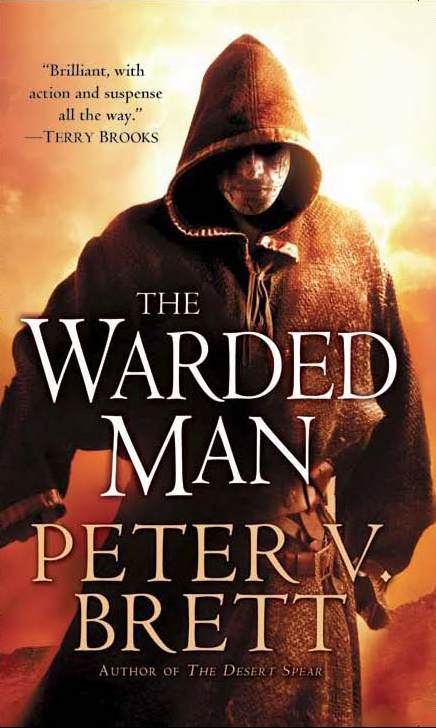
The Warded Man


[Note:  I listed to this as an audiobook.]


The Warded Man is Peter V. Brett's 2007 debut fantasy novel.  I sought it out after hearing it described online as a fresh, modern take on a genre that sees more rehashing than just about any other I can think of.  While Brett's creation has some interesting diversions, overall the writing is unfulfilling and uses a number of the same, tired fantasy elements that are seen again and again in fantasy literature.

The novel is set in a world ravaged by demons.  Each night, the corelings (as they are known), rise from the ground and proceed to wreak havoc on anything they can get their claws on.  After a night of rampaging, they dissolve away in the light of the morning.  The corelings are virtually indestructible, and even the most skilled human warrior would be powerless against them.  Luckily for the humans, a series of wards that are drawn or etched provide a magical net capable of repelling the corelings.  The demon scourge has completely shaped day-to-day life--travel is limited to the daytime, outlying communities are fairly small and isolated, a network of skilled messengers that courier messages and goods between communities has developed, warding is a highly sought after skill, etc.  The worldbuilding in The Warded Man is fairly well realized and definitely the novel's strong point.

As the novel opens, wards are limited to a defensive role, though there are tales of wards long-forgotten that could give humans the power to fight to the demons.  Wait, let me guess...you can see where this is going, right?

In steps Arlen, a...wait for it...ordinary boy from a poor village that has just been ravaged by a demon attack.  After watching his mother die and the cowardice of his father in preventing that death, Arlen vows that his days of cowering in fear of the demons are over.  He sets out to begin training as a messenger in the hopes of honing his martial skills to the point where he can begin to realize his dream of taking the fight to the corelings.  In addition to Arlen, there are two other POV characters, Leesha and Rojer (oh how I hate that name), both also children raised from humble beginnings in outlying villages.  As the novel progresses, the years slip by and the characters grow into adults and assume their roles in the society at large.

Now I won't spoil the big surprise about who the Warded Man turns out to be, but eventually the three characters meet up and are thrust into a desperate fight against a horde of demons bent on destroying Leesha's home village.

Now for the criticism...
1)  It turns out that the plot was working up to...nothing!  I kept waiting for some overarching storyline to assert itself, but other than a vague prophecy about a Deliverer coming to save the humans, there was nothing.  The entire novel works up to a final battle scene with little or no consequence for anyone other than Leesha.
2) We learn absolutely nothing about the corelings other than what they look like and a bit about their animal-like behavior.  Given that they relatively recently returned to the world after being banished for thousands of years, I would expect there is some story to tell there.  To be fair, the novel is clearly written as the first of a series, so perhaps criticism 1 and 2 will be addressed in later volumes.
3) There were some really awkward sexual scenes in the novel that did little or nothing to advance the plot or characterization.  I couldn't help but wonder if, by including these scenes, Brett was trying to make some sort of statement about morality.  It was very reminiscent of Terry Goodkind's proselytizing in the Sword of Truth novels, and, quite frankly, off putting.

To sum up, The Warded Man was a moderately enjoyable novel with a serviceable, if derivative, plot.  However, in the end, the criticisms I've noted above cheapened the reading experience quite a bit.  I'll probably skip the sequel.

Wednesday, April 27, 2011

Antony and Cleopatra


Antony and Cleopatra is Colleen McCullough's 2007 novel that wraps up her epic (and I do mean epic) 'Masters of Rome' series.  While it is good to bring a sense of closure to the series, I think that this novel lacked some of the spark of the previous volumes.  Perhaps McCullough lost a bit of her muse with the death of Julius Caesar in the last volume, The October Horse (though his specter hangs over the entire novel).

[To be fair, it should be noted that McCullough considers the Roman Republic to have ended with the defeat of Caesar's assassins in 42 BC and originally intended to conclude her series with The October Horse.  She buckled to pressure and wrote Antony and Cleopatra to appease her legions (pun definitely intended) of fans.]

The novel opens in 41 BC in the aftermath of the Battle of Phillipi.  Two years before, the Roman world has been divided into two parts (well, to be technical, there are three, but who counts the oft-overlooked Lepidus anyway?):  the west, controlled by Octavian, and the east, by Mark Antony.  The delicate balance of power that has kept the two from each other's throats since the death of Julius Caesar is slowly unraveling.

Octavian struggles to consolidate his power in Italia in the face of growing discontent over the price of wheat, inflated by the constant raiding of that piratical nuisance, Sextus Pompey.  In the east, Mark Antony is intent on leading a campaign against the Parthian empire which he hopes will bring him untold wealth along with the prestige he needs to stand above Octavian once and for all.  Into the mix comes Cleopatra, pharaoh of Egypt and once lover of Julius Caesar, who has her own designs on power in the Mediterranean region.  She recognizes in Mark Antony a tool she can use to promote her own interests (i.e. making her son by Julius Caesar king of Rome) and sets out to ensnare him with first wealth and, later, her feminine wiles.

Antony and Cleopatra is a solid conclusion to the Masters of Rome series--without a doubt it upholds the high standard I've come to expect from McCullough.  The history is well researched.  The characters jump off the page.  At the same time, it lacked the spark of the previous volumes until the very climax of the story (hence the somewhat lower hamster rating).

So there you have it:  after seven books comprising several thousand pages, the events of 110-27 BC come to a conclusion!  Big thanks (and much respect) to Mrs. McCullough for making the events and people of the twilight of the Roman Republic come to life.  Her 'Masters of Rome' series is truly a masterful achievement that I would recommend without hesitation (at least to those with some measure of literary stamina) .

Tuesday, April 19, 2011

The Defection of A.J. Lewinter


A friend recommended The Defection of A.J. Lewinter (1973) by Robert Littell during a recent tour of his bookshelf.  Having just finished an epic game of Twilight Struggle, the novel piqued my interest.  It turned out to be a smart, tightly written novel with a lot to say about the nonsensical nature of espionage.

The novel opens up with the attempted defection of A.J. Lewinter, an academic and specialist in the field of missile ceramics, to the Soviet Union.  While at a scientific conference in Tokyo, he walks into the Soviet embassy offering to share information related to the trajectory of warheads used in the MIRV missile system of the United States.  This is, of course, highly valuable information to the Soviets, as it could facilitate the development of a more capable Soviet missile defense system.

After this opening salvo, the novels alternates between the viewpoints of American and Soviet intelligence agents.  The Americans have to try and determine what, if any, security risk Lewinter's defection poses.  Did he actually have access to any sensitive information?  What were his motives?  It is likewise up to the Soviets to determine what exactly to do with Lewinter and his information.  Should they act on his information?  Is he best used as political propaganda?  Most importantly, could he be an American plant?  Littell does a good job of doling out enough information about Lewinter that any scenario proposed by either side seems plausible.

I didn't expect anything more than a good spy story when I first began the novel.  However, it quickly becomes clear that Littell is smartly commenting on the absurdity of intelligence operations.  Consider the following snippet from a conversation between two of Lewinter's Soviet handlers:
"...it is also possible the Americans were trying to make it appear as if they were reacting to a genuine defection in order to convince us that Lewinter had valuable information.  In which case, he would be a fraud.  Or the Americans may have been trying to convince us he's real knowing we'd discover they were trying to convince us he's real and conclude instead he's a fraud.  Which would mean they want us to think he's a fraud.  Which would mean he's genuine."
The novel is full of little bits that call into question the sanity of high-stakes espionage between the United States and Soviet Union.

The Defection of A.J. Lewinter has little in the way of overt action.  Espionage is portrayed as a highly cerebral psychological game (comparisons to chess are rampant) played by men in small rooms that are worlds apart from each other.  It is undoubtedly a more realistic portrayal of espionage than anything offered by the likes of James Bond or Jason Bourne.

I thoroughly enjoyed the novel, and I look forward to following it up soon with 'The Company,' Littell's definitive work about the American intelligence community.

Thursday, March 31, 2011

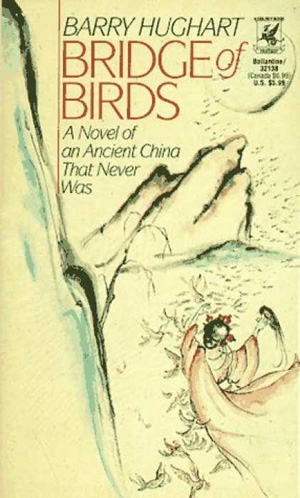
Bridge of Birds


[Another fairly hastily written review as I try to avoid slipping beneath the tidal wave of books waiting to be reviewed!]

Bridge of Birds (1984) by Barry Hughart is a unique novel set in a fantastical, whimsical version of imperial China.  The novel won the World Fantasy Award and seems to have amassed a bit of a cult following.  I first heard about it in a forum posting where people were suggesting their favorite novels.  While it didn't end up being one of my favorites, Bridge of Birds was definitely a singular reading experience!

The novel tells the tale (and what a tale it is) of Lu Yu, better known as Number Ten Ox, and his journey to save the children of his village from a mysterious plague that has beset them during the silk harvest.  Not knowing where to turn, Ox enlists the services of Master Li Kao, a sage found in the back alleys of Peking who is known more for his ability to quaff liquor than anything else.  Master Li turns out to be a brilliant mind and steadfast ally to Ox during the search for the only known cure for the illness:  a legendary plant known as the Great Root of Power.  Indeed, the two travel to the ends of the earth together as they undergo adventures, each more unbelievably outrageous than the last.

Bridge of Birds has a brilliant, zany style that is all its own.  The predicaments that Master Li and Ox find themselves in are all completely over the top, yet somehow they escape again and again (and again).  Hughart manages to keep this manic tone going throughout the entire novel.  In spite of this, I never worried that the story was going to go off the rails (despite the car leaning heavily to the side at times), because each encounter is deftly woven into a fairly complex overarching plot.

As I hinted above, this one wasn't exactly my cup of tea, but that has more to do about my personal taste than any deficit on the part of Bridge of Birds.  Readers looking for a fun read full of madcap adventures would do well to check it out!

Tuesday, March 8, 2011

The Egyptian


The Egyptian (1945) by Mika Waltari tells the fantastic tale of Sinuhe, an Egyptian physician whose life rises and falls like the waters of the river Nile during the tumultuous 14th century BC.  It is a time of great upheaval, with a newly crowned pharaoh forcing a radically different monotheistic religion on the Egyptian empire.  We all know that sort of thing usually turns out...

Sinuhe himself narrates the events of the novel, which opens with him being found in a reed boat on the banks of the river by a poor couple.  Sinuhe follows in the footsteps of his adopted father and trains as a physician.  Just as he is coming of age, the old pharoah, Amenhotep III, falls deathly ill.  Through a chance encounter while tending the dying ruler, he is introduced to the boy who will become the pharaoh Akhenaton and a relationship is forged that will change Sinuhe's life, and indeed all of Egypt, forever.

Despite achieving material success as a physician of great renown in Egypt, Sinuhe is not happy with his life and sets out on a journey around the known world.  Sinuhe's wanderings lead him to visit several of the other civilizations flourishing in the Mediterranean at the time, including Syria, Babylon, and Crete.  He is even so bold as to venture into land of the Hittites, Egypt's main rival for power during the period.  Of course, he has many hair-raising adventures along the way and even manages to fall in love.  He eventually returns to Thebes, where he plays a crucial part in the great drama that is the Egypt of his day.

Waltari has written the novel in a style that is certainly evocative of an ancient tale, though its insights into humanity are timeless.  The character of Sinuhe is entirely believable--sometimes acting foolishly or cruel, at other times wisely and with great kindness.  In short, he is every man. Through his eyes, we see the entire gamut of the human experience from the extreme cruelty of warfare to the heartfelt love of a found soul mate.  His wry, dispassionate observations about his own behavior and that of others are the great strength of The Egyptian and certainly spoke to me.  It is not a novel that I will soon forget!

Thursday, February 17, 2011

The City & The City


The City and The City (2009) by China Mieville was one of two novels that shared the hallowed Hugo Award for best science fiction novel in 2010 (due to a voting tie).  It also won a slew of other literary awards, including the World Fantasy Award.  Being a huge fan of Mieville and a Hugo Award fanboy, I was really looking forward to digging into this one!  The City and The City turns out to be an intriguing, thoughtful novel about how we are trained to view the world around us and what effects it can have.

The novel revolves around two fictional cities located somewhere in eastern Europe:  Beszel and Ul Qoma.  Tyador Borlu of the Extreme Crime Squad is called to investigate the murder of a visiting foreign student found dead in the Beszel streets.  The novel follows his investigation as it unravels into something entirely more sinister than it at first seemed.  

So far, it sounds like it could be the beginning to just about any old detective novel, but here's the Mieville twist that makes it so brilliant:  Beszel and Ul Qoma actually share the same geographic space.  And it turns out that the two cities aren't exactly friendly toward each other.  In fact, the citizens of the two cities actively work to "unsee" people and places in the other city.  Unseeing is a mental process whereby people, places, and events in the other city are ignored.  The act is ingrained in every citizen from birth and held in place by threat of a mysterious force known as "breach" that actively works to ensure the two cities remain divided.  "Breaching," whereby a citizen of one city ignores the separation between the cities, is considered the most heinous of crimes and is dealt with harshly.

Their isolation from one another has led both cities to develop a distinct culture with differences in dress, language, and architecture despite overlapping in geographic space.  As a consequence, Beszel and Ul Qoma are divided into areas that are either total (completely in one city), alter (completely in the other city), or crosshatched (shared by both cities where active unseeing is necessary to avoid breach).  Citizens must be aware at all times of where they are and what they should be seeing.  Fascinating, huh?

I've said before that books that really make me consider the world around me or my place within it are those that I consider some of the best.  Well, to say that The City and The City is thought-provoking is, perhaps, an understatement.  In fact, I've come to think of it as Mieville's grand thought experiment.  It takes something that we all do (i.e. "tune out" parts of the world around us) to the logical extreme, and, in the process, asks us to consider the causes and consequences of our behavior.  Really great stuff!

(Look for a review of the other 2010 Hugo best novel winner, The Windup Girl by Paolo Bacigalupi, soon!)

Tuesday, February 15, 2011

Revelation


Revelation (2008) is another historical mystery novel that comes recommended by way of my mother (Thanks, Mom!). Though it is fourth in a series of historical thrillers that follow the Mathew Shardlake character, it read very well as a standalone novel. With a compelling plot that unfolds in a richly realized Tudor England, Revelation is one of the better mysteries I've read!

Set during post-Reformation England, Revelation fairly drips with atmosphere. It is 1543, and King Henry VIII is in the twilight of his reign. After orchestrating the split of the Church of England from Rome a decade earlier, Henry is returning to more conservative religious views. This leaves two sides of the religious debate, Reformers and Conservatives, once again jockeying for power in England. This makes for a seriously muddy political and religious situation, and the man on the street must measure his words carefully depending on which way the wind is currently blowing. Else, he could easily find himself hanging from a rope for no more than some offhanded remark. This seething mix of religious fervor and paranoia are the perfect setting for Revelation's plot.

In the midst of this political and religious turmoil, we find Mathew Shardlake, a London lawyer who has in his previous exploits garnered more than his fair share of negative attention from those in power. Having sworn never to become involved in state matters again, he, of course, finds himself ensnared in just such a sinister plot at the opening of the novel.

Shardlake's close friend and associate is discovered dead, having been the victim of a most foul and very public murder. Shardlake vows to the victim's widow to track down the killer and with the help of his man, Jack Barak, proceeds to investigate the circumstances of the killing. Unfortunately for Shardlake, his friend is only one victim in a string of murders with religious undertones. Shardlake is drafted into the confidence of Archbishop Cramner and other powerful men with an interest in seeing the case wrapped up as quickly as possible.

The investigation proves to be anything but straightforward, as Shardlake realizes that each murder is imitating the calamities of the seven vials of God's wrath poured out by angels in the Book of Revelation. These vials are some truly Old Testament-style wrath: water turning to blood, the sun scorches the earth, total darkness covers the earth, etc. Sansom does a really clever job of turning his victims into living (or should I say deceased) embodiment of the seven trials. The investigation slowly builds to a climax as Shardlake desperately tries to close in on the killer before he unleashes the final plague upon London, described in Revelation 16:8 as "Then there came flashes of lightning, rumblings, peals of thunder and a severe earthquake. No earthquake like it has ever occurred since mankind has been on earth, so tremendous was the quake." It is quite a compelling race to the finish line!

(All this is to say nothing of the several side plots also unfolding in Revelation. Each is skillfully constructed to reveal more about Shardlake himself and the character of the setting.)

Revelation was really an excellent read. It has just the right mix of atmosphere, characterization, and plot. Usually when reading mystery novels, I'm completely clueless as to the identity of the bad guy (maybe that says more about me than the quality of the book though). There were several times during Revelation when I was sure that I had everything figured out. Of course, it turns out that I was off target, but I think it speaks to Sansom's skill at setting up a believably complex plot.

Any lover of a good mystery (or just a good book in general) should certainly treat themselves to Revelation. I certainly look forward to reading more Matthew Shardlake mysteries in the near future!

Monday, February 7, 2011

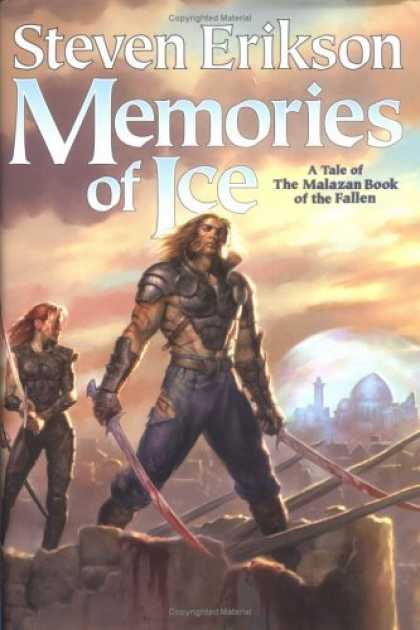
Memories of Ice


Memories of Ice (2001) is the third volume in the Malazan Book of the Fallen (MBotF) series.  It is a serious whopper of a book with the paperback weighing in at a cool 1,187 pages.  While not as good as its predecessor, MoI carries the main plotline forward in an interesting, if not completely gripping, manner.

MoI is the direct sequel to the first novel in the series, Gardens of the Moon, and the events within happen concurrently with those of Deadhouse Gates.  See?  It is already getting complicated, and I haven't even tried to summarize the plot yet.

We once again join the fellows of Whiskeyjack's company in the Malazan army which now finds itself threatened by the Pannion Domin, a powerful army rising out of the south.  It soon becomes clear that there is something altogether sinister with the power behind the Pannion Domin.  As this tide sweeps ever closer to the Malazans, a desperate plan is hatched to forge an alliance with old enemies.

The majority of the novel describes the desperate struggle to hold Capustan from the Domin and is told from both the perspective of soldiers trapped within the city and the Malazan army racing across the continent to relieve the seige.  The climactic struggle for Capustan is really the high watermark of the novel--I've not read many fictional battle scenes described as vividly (or as well) as here.  Erickson does an excellent job of keeping the mood tense and desperate throughout this section of the novel.

Of course, it wouldn't be the MBotF if this action on the prime material plane wasn't part of some grand, cosmic scheming of the gods.  There is plenty of divine, magical intrigue to add to the plot arc that has been building since the first novel.

Memories of Ice definitely has its high points, but, on the whole, I prefer its predecessor more.  The climactic battle scenes were epic, but, boy, did it take a lot of slogging to get there.  Maybe I would have enjoyed it more if it had been broken up into two shorter novels (in fact, there was a perfect place to do just that).  Nevertheless, I still find myself intrigued by the Malazan world and will read on to (hopefully) find some resolution to the main storyline.

Also:  please don't get me started on the cover art--I would rank it as one of the cheeziest covers I've ever seen.  I was actively embarrassed to be seen reading the book in public.

Friday, February 4, 2011

Mouse Guard: Winter 1152


Mouse Guard: Winter 1152 (2008) is the second collection of David Petersen's Mouse Guard comic books.  It collects the six-issue mini series that covers the time immediately following the events of Fall 1152.

Winter has set in and, in the aftermath of the failed uprising put down in the fall, the Guard is scrambling to lay in stores of food, medicine, and sundries in Lockhaven before the roads between settlements become impassable.  Groups of guardmice have been sent out to collect supplies from remote mouse villages and to invite their leaders to a gathering where the issues that contributed to the unrest of the autumn before will be discussed.  The series follows the adventures of a group of these mice as they struggle in the face of the weather and various other dangers to return safely to Lockhaven.

I thought the story itself was somewhat weaker than the previous series.  It seems like Petersen's creativity is being constrained by the need to tell stories in six-issue bursts, particularly given his fairly voluminous art style.  I would really like to see him given the pages to tell a more epic adventure story.  This being said, I'm happy that he spent some time building upon each mouse's personal story.

As in the previous issue, the art is absolutely gorgeous.  It was great getting to see some more exotic locations in the Mouse Guard world as well as different denizens of the surrounding forests.  Here's a small sample of the rich texturing and attention to deal that characterizes Petersen's art:


As with the first volume, the art more than makes up for anything that the story lacks.  Petersen's next series, entitled The Black Axe, is just making its way into comic form now.  I look forward to picking up his next collection when it becomes available!

Friday, January 7, 2011

The Great Divorce


And now for something completely different...at least different from the epic fantasies I have been reviewing of late....

To preface the review, I am both a Christian and unapologetic C.S. Lewis fan.  While both of these things will obviously color my review, I think that any thoughtful reader will be able to take away a great deal from this short novel.

The Great Divorce (1945) by C.S. Lewis is a fantasy in which the narrator sets out on a bus excursion from a dull, gray city where he has inexplicably arrived.  He and his fellow passengers soon disembark at what turns out to be the foothills of heaven.  In this beautiful environment, they find themselves to be mere ghosts, unable to interact with the more substantive environment around them.  They are soon greeted by shining figures who are the incarnations of people they have known while on earth.  These spirits urge the passengers individually to turn away from their former lives and put their whole trust in heaven.  The narrator observes several interactions between passengers and spirits and finds that the majority for various reasons are unable to make such a commitment.  These passengers return to the bus and the drab existence that awaits them in the the gray world below (understood to be hell).

What I love about C.S. Lewis is his uncanny ability put into words the excuses, lies, and rationalizations that keep us all away from heaven.  The narrator observes a minister who can't believe he has arrived at heaven since it doesn't fit his preconceived notion, an artist who is incredulous that he will not be able to exhibit his art in heaven, and a mother who is outraged that her son did not greet her upon her arrival.  Each of these passengers returns to the bus (in fact, C.S. Lewis cleverly titled the original novel Who Goes Home?).  As in his work The Screwtape Letters, Lewis reminds us that one does not arrive at hell due to a single horrific act.  Rather it is the sum total of each word, thought, or deed in our lives (for what else are we?) that will decide our ultimate fate.

The narrator finally meets his own shining spirit who turns out to be the writer, George MacDonald (whose works highly influenced Lewis' own).  MacDonald explains that people are able to enter heaven only if they repent completely.  Upon doing so, the power of heaven is so great it is able to work backwards in a person's life, making their earthly existence an extension of heaven.  Conversely, for those who turn away, the power of hell can retroactively change the joy in a person's life into unbearable misery.

I thoroughly enjoyed The Great Divorce, and whether or not you understand the various literary allusions (and it has lots) or fairly hefty theology, a thoughtful reader can't help but come away from the novel with some interesting insights into humanity.

Wednesday, January 5, 2011

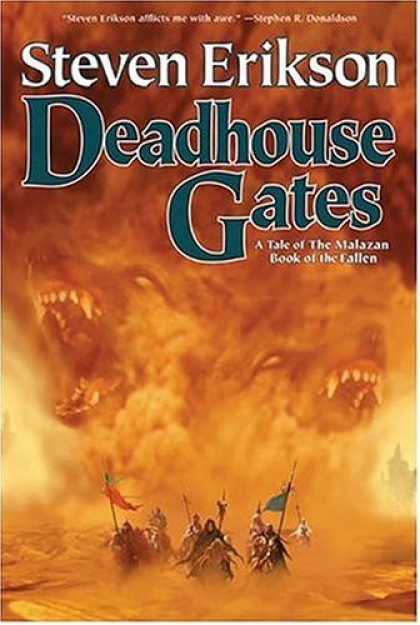
Deadhouse Gates


[Alright, the time has come for me to bite the bullet and write this review of the second book in the Malazan Book of the Fallen series.  I finished it way back before Thanksgiving and have put off reviewing it...I seem to have this reluctance every time i read one of these fantasies that span several novels.]

Deadhouse Gates (2000) generally continues the story introduced in the first novel of the series, Gardens of the Moon (GotM).  Though the action in this novel takes place on another continent, a few of the characters from GotM are crucial participants in events as they unfold in DG.

To distill an extremely complex story down to its essentials, we follow an apocalyptic uprising known as The Whirlwind foretold by an ancient prophecy (what fantasy epic would be complete without an ancient prophecy?).  We learn the unlikely circumstances behind its leader and some of her motivations for ridding the world of the Malazan Empire.  Much of the novel follows a garrison of Malazan soldiers under the command of a foreign warrior across the desert in their desperate attempt to stave off the rebel force.  There are some fantastic battle scenes where the Malazans use some clever tactics to hold off the vastly numerically superior Whirlwind force.  This being the Malazan universe, there are also a fair number of powerful beings (be they gods or merely so-called "Ascendant" mortals) meddling around in everybody's affairs.

Astute followers of my blog (all two of you) will recall that while I was quite intrigued by the Malazan universe, I had some gripes with Gardens of the Moon.  The most notable being that the reader is thrown head first into an extremely complex plot with close to no context for anything that is happening. Well, I'm glad to say that DG was much easier to follow than its predecessor.  Not only did I have a better grasp of the Malazan world and magic this time around, but Erikson does a more skillful job of building the plot.  The action slowly builds to high tension and is then rips loose near the end of the novel where there are some really memorable scenes.

All-in-all, Deadhouse Gates is a better novel than its predecessor.  Seeing as how I'm currently reading the fourth book in the Malazan Book of the Fallen (told you I was falling behind with my reviews), I would recommend continuing the series!