Agent Zigzag (2007) opens with a scene straight out of the movies. Two lovebirds are relaxing in a restaurant enjoying a romantic dinner when, all of a sudden, two policeman appear, prompting the man to dive through a glass window and run up the beach to evade his pursuers. This incident seems to nicely encapsulate the life and times of Edward Chapman, the man whose story Ben McIntyre has set out to tell in Agent Zigzag.
Eddie Chapman is a flamboyant, complicated character who spent much of his life on the wrong side of the law. He is also, incredibly, one of the most successful double agents ever to operate for British intelligence. This seeming dichotomy of character makes for a fascinating read.
When the story opens, he is involved in a gang of safe crackers implicated in a string of robberies in Britain. He winds up incarcerated on the island of Jersey when World War 2 breaks out and the island is captured by Nazi Germany. In a fairly ill-conceived bid to gain freedom, Chapman volunteers his services as a spy for the Germans.
He is eventually recruited and trained by the Abwehr to carry out sabotage missions within Britain. His background as a criminal made him a particularly appealing candidate as a spy to the Germans. Analysis suggested he was likely to feel ill-treated by the British and, as a result, less inclined to turn sides once released into Britain. Also, his expertise with using explosives to crack safes could be harnessed for more sinister purposes. Of course, Chapman, a consummate liar, did everything possible to reinforce these ideas.
Following a period of rigorous training, Chapman parachutes into Britain in the dead of night with orders to blow up an airplane production plant. Instead of proceeding as planned, he heads straight to MI5 to volunteer as a double agent working for British intelligence! While he is at first greeted with surprise and distrust, the British eventually realize what a useful tool they might have at their disposal.
Most of the account details his retraining by the British and subsequent missions working for both sides in Germany, Norway, and Britain. Chapman, though brilliant, is prone to wild mood swings, fits of bravado, and bouts of romanticism. This kind of behavior has his British and German handlers constantly on edge and questioning his motives--both sides are constantly confronted with the question of whether he is worth all the fuss.
Agent Zigzag is a highly compelling account of an almost larger-than-life personality. At times, it is difficult to believe that Chapman's story is not fiction!
Showing posts with label ww2. Show all posts
Monday, May 17, 2010
Thursday, March 11, 2010
Night
Night is the Holocaust memoir of Nobel laureate Elie Wiesel. To say that it is only a memoir, however, would be doing an extreme injustice to the work. The narrative ultimately draws on themes that we all struggle with in our lives at some point: the meaning of faith, death, family, and the importance of memory.
The New York Times describes the 107-page book as "A slim volume of terrifying power." I can't think of a better way to describe Night, so I'm going to leave it at that. Read the book and never forget.
Tuesday, February 23, 2010
Hitler's Scientists: Science, War, and the Devil's Pact
The book is by John Cornwell, an English author most famous for Hitler's Pope (1999), a somewhat controversial (to put it lightly) work that contends that Pope Pius XII did not do enough to stand up to Nazi Germany during the Second World War.
Hitler's Scientists presents a detailed description of the state of science in Germany in the decades surrounding World War 2. Such varied fields as medicine, biology, racial "science," physics, and conventional weaponry are discussed, always in light of the prevailing political climate of Nazi Germany. Two areas of research, the nuclear program under Werner Heisenberg and the rocket program headed by Wernher von Braun, receive special attention due to their importance (or seeming importance, anyway) for the German war effort and their consequent impact on the Cold War. The final chapters of the book examine how the ethical legacy of the Nazi scientists should temper the behavior of the scientific community in the present day.
It becomes clear that a hallmark of German science and technology development during the Nazi period is its highly fragmented nature. Hitler encouraged infighting (whether deliberate or through unskillful management) between the various personalities, cliques, and groups which constituted his government. As a result, many small groups were often working toward the same goal under different auspices with no knowledge of one another (let alone the science). Compare this to the centralized nature of the Manhattan Project and its policy of information sharing, and it is no wonder the Allies were able to win the race to an atomic weapon (remember, it wasn't until the very end of 1944 that the Allies conclusively knew that Germany did not have the capability to build an atomic weapon).
Alongside the historical account, Cornwell poses his central thesis. Namely, can science be free from the taint of politics? Should scientists consider their work within a vacuum or are they obligated to examine the possible consequences of their research? From the subtitle of the book, I think you can easily surmise that Cornwell absolutely rejects the idea that scientists are not responsible for the ultimate outcomes of their work.
Another interesting question raised by Cornwell is whether science in a totalitarian society inherently differs from that pursued in a democracy? Is a democracy better equipped to conduct science in an ethical manner or handle the resulting technologies in a more responsible manner? A number of incidents (e.g. the use of the atomic bomb, the Tuskegee syphilis experiments) suggest that this might not be the case.
For dealing with what some might consider a fairly dry subject, I found the book extremely easy to read--in fact, it was a real page-turner. I would recommend Hitler's Scientists to those who have an interest in the impact science can have on world at large.
Monday, November 23, 2009
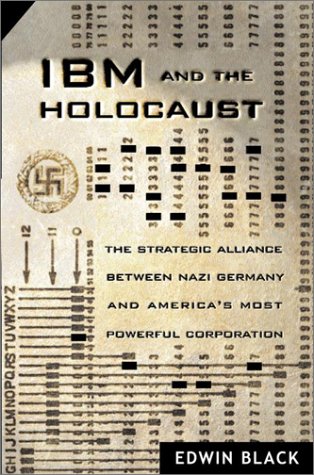
IBM and the Holocaust
I was extremely excited to come across this book as it involves a couple of topics in which I'm extremely interested--early computing and World War 2--with a good dash of conspiracy thrown in. So interested, in fact, that it zoomed right to the top of my reading pile...I actually went bookless for two days waiting for it to arrive in the mail. My wife can tell you that this is an unprecedented turn of events!
Edwin Black does a magnificent job detailing the role that the technology controlled by International Business Machines played in accelerating the pace of the Holocaust. In the introduction to the book, Black unequivocally states so as the reader does not make a mistake: the Holocaust would have still happened without IBM's involvement. However, without the automation supplied by IBM, the process would have been vastly less efficient. Case in point: the stark contrast between the high percentage of Jews eliminated in Holland (which had an established IBM presence and expertise in automated census counting) and the much lower rate in France (where the market for automated census equipment was fragmented and not well developed).
To make an extremely complex story short, IBM controlled the world's leading technology for tabulation and subsequent sorting of populations, the Hollerith machine. These machines functioned by reading special punch cards representing digital data, and had been used in the early part of the century to automate census counts in the United States and several European countries. Despite clear indications that this technology was being used for nefarious purposes by the Nazi party in Germany (and later in conquered territories), IBM, through its German subsidiary, Dehomag, funneled machines and the paper necessary to run them into the Reich. Throughout the 1930s and into the war, the president of IBM, Thomas J. Watson (who incidentally is often hailed as a hero of American business), formulated a deliberate policy to maintain plausible deniability for his firm's actions that aided the enemy in both its war effort and its campaign to effect the Final Solution to the Jewish problem.
One gripe: I would have liked the account to have had a more technical discussion of how Hollerith machines used. I understand on a basic level how alphabetizing and sequential sorting based on categories could be applied to counting people. However, how these operations might be applied to something as complicated as cargo scheduling and maintaining a train transportation network were not clear to me.
Reading the book has given me a new perspective on the power of a census. The information (in many cases) voluntarily given to the Nazis by many Jews spelled their own doom throughout the Reich. The next time I'm filling out a form asking for seemingly unimportant personal details I might give pause to consider how the information might be used.
I went into this book not knowing how I would react. Isn't the job of a multinational corporation such as IBM to make money? I would suggest that the answer is "yes" but there is a moral line that should not be crossed to do so. Black's account proves that IBM didn't just step over the line but kept on walking and didn't look back. One example: IBM sent technicians into concentration camps to service the Hollerith machines that were clacking away sorting Jews to the gas chamber. It is a story of greed gone unchecked--there is no doubt in my mind that IBM, and particularly Thomas J. Watson, has blood on their hands.
Edwin Black does a magnificent job detailing the role that the technology controlled by International Business Machines played in accelerating the pace of the Holocaust. In the introduction to the book, Black unequivocally states so as the reader does not make a mistake: the Holocaust would have still happened without IBM's involvement. However, without the automation supplied by IBM, the process would have been vastly less efficient. Case in point: the stark contrast between the high percentage of Jews eliminated in Holland (which had an established IBM presence and expertise in automated census counting) and the much lower rate in France (where the market for automated census equipment was fragmented and not well developed).
One gripe: I would have liked the account to have had a more technical discussion of how Hollerith machines used. I understand on a basic level how alphabetizing and sequential sorting based on categories could be applied to counting people. However, how these operations might be applied to something as complicated as cargo scheduling and maintaining a train transportation network were not clear to me.
Reading the book has given me a new perspective on the power of a census. The information (in many cases) voluntarily given to the Nazis by many Jews spelled their own doom throughout the Reich. The next time I'm filling out a form asking for seemingly unimportant personal details I might give pause to consider how the information might be used.
I went into this book not knowing how I would react. Isn't the job of a multinational corporation such as IBM to make money? I would suggest that the answer is "yes" but there is a moral line that should not be crossed to do so. Black's account proves that IBM didn't just step over the line but kept on walking and didn't look back. One example: IBM sent technicians into concentration camps to service the Hollerith machines that were clacking away sorting Jews to the gas chamber. It is a story of greed gone unchecked--there is no doubt in my mind that IBM, and particularly Thomas J. Watson, has blood on their hands.
Thursday, November 5, 2009
A Man Called Intrepid
This fascinating book describes the birth and early years of Allied secret operations during World War 2. The narrative centers around one man, William Stephenson (or INTREPID if you prefer his codename), a Canadian man of many (and considerable) talents who held the ear of both Churchill and Roosevelt. Stephenson had an amazing ability to apply his substantial intellect to the merger of science and business during peacetime. When it became apparent during the 1930s that war would soon come to Britain, he transitioned his efforts away from business to preparing covert operations for the Allies. His many contacts and relationships from around the world were a perfect cover for the people, products necessary for such an undertaking.
All sorts of capers against the backdrop of WW2 are recounted in A Man Called Intrepid. There was the plot to destroy the Nazi-controlled Norsk Hydro plant in Norway to cut off Germany's supply of heavy water that might be used to develop atomic weapons. There was the tale of the huge intelligence apparatus set up in Bermuda to monitor all incoming mail ships for the presence of Nazi correspondence (such as film microdots hidden in the periods of sentences!). There was the story of the "famed Hungarian astrologer" who toured the world predicting Hitler's doom but was actually a hired hand of the BSC and OSS. Documents were forged on typewriters that were constructed to have flaws identical to those seen in stolen papers originating from particular Nazi offices. The list goes on and on...
I was struck by how every detail of an operation was meticulously carried out, down to "collecting" (voluntarily or otherwise) authentic European clothing and personal articles from overseas travelers entering America for use by agents working undercover.
The book does an excellent job recounting the political feeling in the United States in the years leading up to our entry in the war. For instance, I had no idea that Roosevelt was forced to walk such a fine line in America with regards to his policy toward aid to Britain. He was constantly under assault from isolationists as a war monger and even had to put up with pro-Nazi elements in the US government (note that the majority of these people did not support Nazi policies per se but were deluding themselves as to the scope of Hitler's plan).
Overall, an extremely interesting book that tells many of the stories not found in histories of conventional warfare. I recommend it!
All sorts of capers against the backdrop of WW2 are recounted in A Man Called Intrepid. There was the plot to destroy the Nazi-controlled Norsk Hydro plant in Norway to cut off Germany's supply of heavy water that might be used to develop atomic weapons. There was the tale of the huge intelligence apparatus set up in Bermuda to monitor all incoming mail ships for the presence of Nazi correspondence (such as film microdots hidden in the periods of sentences!). There was the story of the "famed Hungarian astrologer" who toured the world predicting Hitler's doom but was actually a hired hand of the BSC and OSS. Documents were forged on typewriters that were constructed to have flaws identical to those seen in stolen papers originating from particular Nazi offices. The list goes on and on...
I was struck by how every detail of an operation was meticulously carried out, down to "collecting" (voluntarily or otherwise) authentic European clothing and personal articles from overseas travelers entering America for use by agents working undercover.
The book does an excellent job recounting the political feeling in the United States in the years leading up to our entry in the war. For instance, I had no idea that Roosevelt was forced to walk such a fine line in America with regards to his policy toward aid to Britain. He was constantly under assault from isolationists as a war monger and even had to put up with pro-Nazi elements in the US government (note that the majority of these people did not support Nazi policies per se but were deluding themselves as to the scope of Hitler's plan).
Overall, an extremely interesting book that tells many of the stories not found in histories of conventional warfare. I recommend it!
Subscribe to:
Posts (Atom)