Showing posts with label fantasy. Show all posts

Wednesday, May 9, 2012

The Wind Through the Keyhole


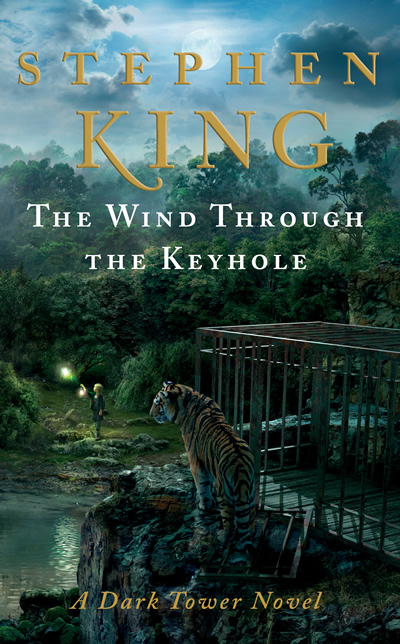
Fear not, dear reader!  I've once again been shaken out of silence.  This time to review a book hot off the press.  Stephen King's The Wind Through the Keyhole (2012) is what faithful fans of his Dark Tower series, myself included, have spent years waiting for.  No, not word of yet another TV or film adaptation that will ultimately be relegated to the clearing at the end of the path.  A new novel!

The Wind Through the Keyhole falls in between Wizard and Glass and The Wolves of the Calla, and so can be considered volume #4.5 of the Dark Tower.  During their journey away from the Emerald City, Roland and his ka-tet are forced to seek shelter from a once-in-a-generation storm known as the starkblast.  With all hell breaking loose outside, Roland settles down to tell a tale that harkens back to the year following his mother's death when gunslingers were still a force of law in Mid-World.

Roland is sent by his father to investigate a series of mysterious deaths in an outlying holding thought to be the work of a skin man, aka a shapeshifter. In the aftermath of a fresh attack by the skin man, he befriends a boy who has lost his entire family to the creature.  To calm him down and lend the boy strength, Roland relates a bedtime story told to him by his mother (who is oft on his mind in the wake of her death)--the legend of Tim Stoutheart and his dealings with Marten Broadcloak (aka the Man in Black, Randall Flagg), agent of the Crimson King and longtime nemesis of Roland himself.

The story of Tim Stoutheart and his coming of age provides the bulk of The Wind Through the Keyhole.  Through this narration, we get a portrait of the world before it has moved on (an aspect of the series which I find particularly interesting).  All the usual suspects that make the Dark Tower universe so compelling are there: cowboys, gunslingers, wizards, dragons, North Central Positronics, etc.  Tim's story is heartfelt and quite charming, adding a light interlude to relieve the otherwise on-the-whole gritty series.  Coming right off the events of Wizard and Glass, I think even the heartiest reader could use a bit of a breather!

While The Wind Through the Keyhole doesn't add heaps to the overall Dark Tower narrative, it nicely gives some further insight into Roland's character, particularly as it relates to the tragic circumstances of his mother's death.

It was really fabulous to spend some time with Roland and his ka-tet again, for I have rarely felt more of a connection to a group of characters.  There was the merest whisper of a hint that we might not have heard the last of Tim Stoutheart, so here's to hoping that King will treat us fans to more of the Dark Tower in the years to come!

A final tidbit:  one of the guardians of the Beams, who just happens to be a lion, is named Aslan!  How cool is that?

Monday, August 8, 2011

A Dance With Dragons


Never fear, dear reader, I've not forgotten about the blog but, rather, have been attending to more important things in real life (like earning a Ph.D.).  As it happens, it takes one of the biggest publishing events in geekdom to draw me out of my silence.  So, without further ado:

[Don't worry, I'm not going to include any real spoilers in the review.]

Unless you've been living under a rock lately, you probably know about George R.R. Martin's epic fantasy series, A Song of Ice and Fire (ASOIAF).  The HBO series based on the first novel in the series, A Game of Thrones, has been hugely successful and drawn people to ASOIAF that I otherwise would never have expected to show any interest.  My Goodreads and Facebook feeds have lit up in recent weeks with people talking about ASOIAF.  We're talking females who I went to high school here, for goodness sakes.  The powers of HBO are truly mind boggling.

Well, A Dance With Dragons is the fifth novel in ASOIAF.  It has been in the works for six, count 'em, SIX years.  Everyone (read:  geeks on the internet) was getting a bit worried about GRRM's ability to pull this one off after his long delay.  Also, he is not exactly a young man (or a particularly healthy-looking man for that matter), so this break was (is?) possibly threatening the completion of the series (let's not forget the tragic death of Robert Jordan).  Well, I'm happy to say that GRRM's latest novel is a solid effort; GRRM has lost none of his flair with the quill.

So:  Is there action? Adventure? Intrigue? Violence? Sex?  Fire-breathing dragons?  The answer to all these is, happily, YES!  Do we meet up with our favorite characters so cruelly abandoned in A Feast for Crows?  Yes!  Are there any events that are going to rock the foundations of ASOIAF?  I guess so (note the lack of enthusiasm; see below).

So what gives?  Why the 3.5 hamster rating?  While the novel has all these things and more, you will be forced to meander with each character across Westeros and the Free Cities many times over in between encounters of substance.  No form of transportation has been left out:  wagon, river boat, horse, sea galleon, and, most importantly, good ol' feet.  A Dance With Dragons cries out for a good editor--I could cut several hundred pages out of the book without raising a sweat and there would more than ample room to tell the same story.

This brings me to my biggest problem with the novel.  Simply put:  the novel spectacularly fails to push the main plot forward.  Characters are shuttled around the world, some things happen, but the threads of main plot are coming together so achingly slowly (or in several cases not at all), at this rate it is going to take at least 15 more books to reach some semblance of a conclusion to all this.

All this being said, the novel is a good read, certainly better than A Feast for Crows.  I look forward with great anticipation to the next book in the series, so I guess on that account, A Dance With Dragons is a spectacular success!

Thursday, April 28, 2011

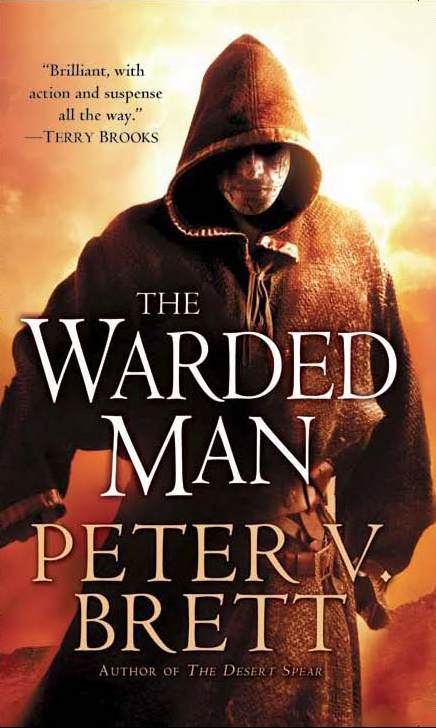
The Warded Man


[Note:  I listed to this as an audiobook.]


The Warded Man is Peter V. Brett's 2007 debut fantasy novel.  I sought it out after hearing it described online as a fresh, modern take on a genre that sees more rehashing than just about any other I can think of.  While Brett's creation has some interesting diversions, overall the writing is unfulfilling and uses a number of the same, tired fantasy elements that are seen again and again in fantasy literature.

The novel is set in a world ravaged by demons.  Each night, the corelings (as they are known), rise from the ground and proceed to wreak havoc on anything they can get their claws on.  After a night of rampaging, they dissolve away in the light of the morning.  The corelings are virtually indestructible, and even the most skilled human warrior would be powerless against them.  Luckily for the humans, a series of wards that are drawn or etched provide a magical net capable of repelling the corelings.  The demon scourge has completely shaped day-to-day life--travel is limited to the daytime, outlying communities are fairly small and isolated, a network of skilled messengers that courier messages and goods between communities has developed, warding is a highly sought after skill, etc.  The worldbuilding in The Warded Man is fairly well realized and definitely the novel's strong point.

As the novel opens, wards are limited to a defensive role, though there are tales of wards long-forgotten that could give humans the power to fight to the demons.  Wait, let me guess...you can see where this is going, right?

In steps Arlen, a...wait for it...ordinary boy from a poor village that has just been ravaged by a demon attack.  After watching his mother die and the cowardice of his father in preventing that death, Arlen vows that his days of cowering in fear of the demons are over.  He sets out to begin training as a messenger in the hopes of honing his martial skills to the point where he can begin to realize his dream of taking the fight to the corelings.  In addition to Arlen, there are two other POV characters, Leesha and Rojer (oh how I hate that name), both also children raised from humble beginnings in outlying villages.  As the novel progresses, the years slip by and the characters grow into adults and assume their roles in the society at large.

Now I won't spoil the big surprise about who the Warded Man turns out to be, but eventually the three characters meet up and are thrust into a desperate fight against a horde of demons bent on destroying Leesha's home village.

Now for the criticism...
1)  It turns out that the plot was working up to...nothing!  I kept waiting for some overarching storyline to assert itself, but other than a vague prophecy about a Deliverer coming to save the humans, there was nothing.  The entire novel works up to a final battle scene with little or no consequence for anyone other than Leesha.
2) We learn absolutely nothing about the corelings other than what they look like and a bit about their animal-like behavior.  Given that they relatively recently returned to the world after being banished for thousands of years, I would expect there is some story to tell there.  To be fair, the novel is clearly written as the first of a series, so perhaps criticism 1 and 2 will be addressed in later volumes.
3) There were some really awkward sexual scenes in the novel that did little or nothing to advance the plot or characterization.  I couldn't help but wonder if, by including these scenes, Brett was trying to make some sort of statement about morality.  It was very reminiscent of Terry Goodkind's proselytizing in the Sword of Truth novels, and, quite frankly, off putting.

To sum up, The Warded Man was a moderately enjoyable novel with a serviceable, if derivative, plot.  However, in the end, the criticisms I've noted above cheapened the reading experience quite a bit.  I'll probably skip the sequel.

Thursday, March 31, 2011

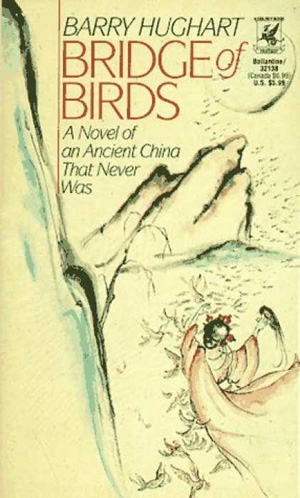
Bridge of Birds


[Another fairly hastily written review as I try to avoid slipping beneath the tidal wave of books waiting to be reviewed!]

Bridge of Birds (1984) by Barry Hughart is a unique novel set in a fantastical, whimsical version of imperial China.  The novel won the World Fantasy Award and seems to have amassed a bit of a cult following.  I first heard about it in a forum posting where people were suggesting their favorite novels.  While it didn't end up being one of my favorites, Bridge of Birds was definitely a singular reading experience!

The novel tells the tale (and what a tale it is) of Lu Yu, better known as Number Ten Ox, and his journey to save the children of his village from a mysterious plague that has beset them during the silk harvest.  Not knowing where to turn, Ox enlists the services of Master Li Kao, a sage found in the back alleys of Peking who is known more for his ability to quaff liquor than anything else.  Master Li turns out to be a brilliant mind and steadfast ally to Ox during the search for the only known cure for the illness:  a legendary plant known as the Great Root of Power.  Indeed, the two travel to the ends of the earth together as they undergo adventures, each more unbelievably outrageous than the last.

Bridge of Birds has a brilliant, zany style that is all its own.  The predicaments that Master Li and Ox find themselves in are all completely over the top, yet somehow they escape again and again (and again).  Hughart manages to keep this manic tone going throughout the entire novel.  In spite of this, I never worried that the story was going to go off the rails (despite the car leaning heavily to the side at times), because each encounter is deftly woven into a fairly complex overarching plot.

As I hinted above, this one wasn't exactly my cup of tea, but that has more to do about my personal taste than any deficit on the part of Bridge of Birds.  Readers looking for a fun read full of madcap adventures would do well to check it out!

Monday, February 7, 2011

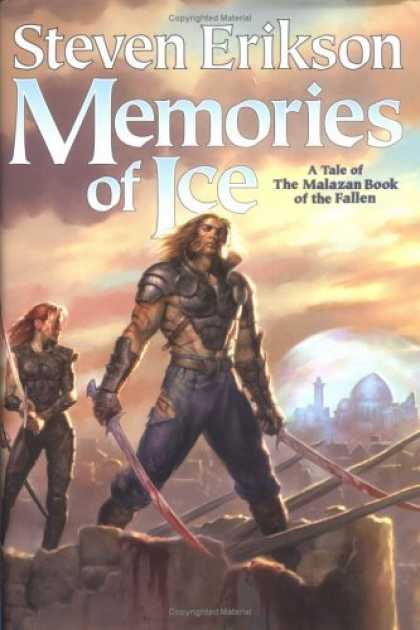
Memories of Ice


Memories of Ice (2001) is the third volume in the Malazan Book of the Fallen (MBotF) series.  It is a serious whopper of a book with the paperback weighing in at a cool 1,187 pages.  While not as good as its predecessor, MoI carries the main plotline forward in an interesting, if not completely gripping, manner.

MoI is the direct sequel to the first novel in the series, Gardens of the Moon, and the events within happen concurrently with those of Deadhouse Gates.  See?  It is already getting complicated, and I haven't even tried to summarize the plot yet.

We once again join the fellows of Whiskeyjack's company in the Malazan army which now finds itself threatened by the Pannion Domin, a powerful army rising out of the south.  It soon becomes clear that there is something altogether sinister with the power behind the Pannion Domin.  As this tide sweeps ever closer to the Malazans, a desperate plan is hatched to forge an alliance with old enemies.

The majority of the novel describes the desperate struggle to hold Capustan from the Domin and is told from both the perspective of soldiers trapped within the city and the Malazan army racing across the continent to relieve the seige.  The climactic struggle for Capustan is really the high watermark of the novel--I've not read many fictional battle scenes described as vividly (or as well) as here.  Erickson does an excellent job of keeping the mood tense and desperate throughout this section of the novel.

Of course, it wouldn't be the MBotF if this action on the prime material plane wasn't part of some grand, cosmic scheming of the gods.  There is plenty of divine, magical intrigue to add to the plot arc that has been building since the first novel.

Memories of Ice definitely has its high points, but, on the whole, I prefer its predecessor more.  The climactic battle scenes were epic, but, boy, did it take a lot of slogging to get there.  Maybe I would have enjoyed it more if it had been broken up into two shorter novels (in fact, there was a perfect place to do just that).  Nevertheless, I still find myself intrigued by the Malazan world and will read on to (hopefully) find some resolution to the main storyline.

Also:  please don't get me started on the cover art--I would rank it as one of the cheeziest covers I've ever seen.  I was actively embarrassed to be seen reading the book in public.

Friday, February 4, 2011

Mouse Guard: Winter 1152


Mouse Guard: Winter 1152 (2008) is the second collection of David Petersen's Mouse Guard comic books.  It collects the six-issue mini series that covers the time immediately following the events of Fall 1152.

Winter has set in and, in the aftermath of the failed uprising put down in the fall, the Guard is scrambling to lay in stores of food, medicine, and sundries in Lockhaven before the roads between settlements become impassable.  Groups of guardmice have been sent out to collect supplies from remote mouse villages and to invite their leaders to a gathering where the issues that contributed to the unrest of the autumn before will be discussed.  The series follows the adventures of a group of these mice as they struggle in the face of the weather and various other dangers to return safely to Lockhaven.

I thought the story itself was somewhat weaker than the previous series.  It seems like Petersen's creativity is being constrained by the need to tell stories in six-issue bursts, particularly given his fairly voluminous art style.  I would really like to see him given the pages to tell a more epic adventure story.  This being said, I'm happy that he spent some time building upon each mouse's personal story.

As in the previous issue, the art is absolutely gorgeous.  It was great getting to see some more exotic locations in the Mouse Guard world as well as different denizens of the surrounding forests.  Here's a small sample of the rich texturing and attention to deal that characterizes Petersen's art:


As with the first volume, the art more than makes up for anything that the story lacks.  Petersen's next series, entitled The Black Axe, is just making its way into comic form now.  I look forward to picking up his next collection when it becomes available!

Friday, January 7, 2011

The Great Divorce


And now for something completely different...at least different from the epic fantasies I have been reviewing of late....

To preface the review, I am both a Christian and unapologetic C.S. Lewis fan.  While both of these things will obviously color my review, I think that any thoughtful reader will be able to take away a great deal from this short novel.

The Great Divorce (1945) by C.S. Lewis is a fantasy in which the narrator sets out on a bus excursion from a dull, gray city where he has inexplicably arrived.  He and his fellow passengers soon disembark at what turns out to be the foothills of heaven.  In this beautiful environment, they find themselves to be mere ghosts, unable to interact with the more substantive environment around them.  They are soon greeted by shining figures who are the incarnations of people they have known while on earth.  These spirits urge the passengers individually to turn away from their former lives and put their whole trust in heaven.  The narrator observes several interactions between passengers and spirits and finds that the majority for various reasons are unable to make such a commitment.  These passengers return to the bus and the drab existence that awaits them in the the gray world below (understood to be hell).

What I love about C.S. Lewis is his uncanny ability put into words the excuses, lies, and rationalizations that keep us all away from heaven.  The narrator observes a minister who can't believe he has arrived at heaven since it doesn't fit his preconceived notion, an artist who is incredulous that he will not be able to exhibit his art in heaven, and a mother who is outraged that her son did not greet her upon her arrival.  Each of these passengers returns to the bus (in fact, C.S. Lewis cleverly titled the original novel Who Goes Home?).  As in his work The Screwtape Letters, Lewis reminds us that one does not arrive at hell due to a single horrific act.  Rather it is the sum total of each word, thought, or deed in our lives (for what else are we?) that will decide our ultimate fate.

The narrator finally meets his own shining spirit who turns out to be the writer, George MacDonald (whose works highly influenced Lewis' own).  MacDonald explains that people are able to enter heaven only if they repent completely.  Upon doing so, the power of heaven is so great it is able to work backwards in a person's life, making their earthly existence an extension of heaven.  Conversely, for those who turn away, the power of hell can retroactively change the joy in a person's life into unbearable misery.

I thoroughly enjoyed The Great Divorce, and whether or not you understand the various literary allusions (and it has lots) or fairly hefty theology, a thoughtful reader can't help but come away from the novel with some interesting insights into humanity.

Wednesday, January 5, 2011

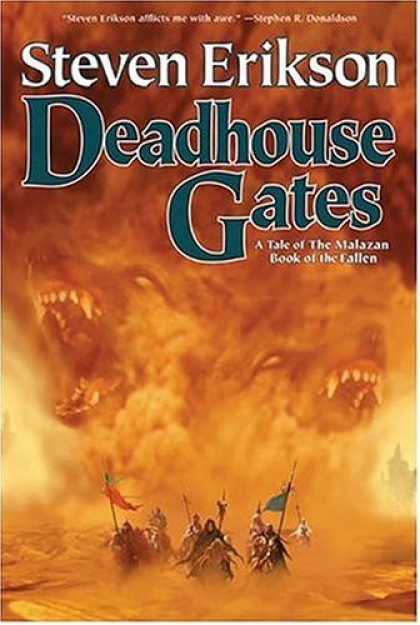
Deadhouse Gates


[Alright, the time has come for me to bite the bullet and write this review of the second book in the Malazan Book of the Fallen series.  I finished it way back before Thanksgiving and have put off reviewing it...I seem to have this reluctance every time i read one of these fantasies that span several novels.]

Deadhouse Gates (2000) generally continues the story introduced in the first novel of the series, Gardens of the Moon (GotM).  Though the action in this novel takes place on another continent, a few of the characters from GotM are crucial participants in events as they unfold in DG.

To distill an extremely complex story down to its essentials, we follow an apocalyptic uprising known as The Whirlwind foretold by an ancient prophecy (what fantasy epic would be complete without an ancient prophecy?).  We learn the unlikely circumstances behind its leader and some of her motivations for ridding the world of the Malazan Empire.  Much of the novel follows a garrison of Malazan soldiers under the command of a foreign warrior across the desert in their desperate attempt to stave off the rebel force.  There are some fantastic battle scenes where the Malazans use some clever tactics to hold off the vastly numerically superior Whirlwind force.  This being the Malazan universe, there are also a fair number of powerful beings (be they gods or merely so-called "Ascendant" mortals) meddling around in everybody's affairs.

Astute followers of my blog (all two of you) will recall that while I was quite intrigued by the Malazan universe, I had some gripes with Gardens of the Moon.  The most notable being that the reader is thrown head first into an extremely complex plot with close to no context for anything that is happening. Well, I'm glad to say that DG was much easier to follow than its predecessor.  Not only did I have a better grasp of the Malazan world and magic this time around, but Erikson does a more skillful job of building the plot.  The action slowly builds to high tension and is then rips loose near the end of the novel where there are some really memorable scenes.

All-in-all, Deadhouse Gates is a better novel than its predecessor.  Seeing as how I'm currently reading the fourth book in the Malazan Book of the Fallen (told you I was falling behind with my reviews), I would recommend continuing the series!

Tuesday, November 2, 2010

Gardens of the Moon


I caught wind of Gardens of the Moon (1999) in a thread of recommended books over on BGG.  I had not heard of it before and was surprised to see that it has garnered an almost fanatical following among some internet circles (the kind that argue over whether GRRM's ASOIAF or Tolkein's LOR is the best series EVAR!).  The internet fanboys promised world building on a grand scale, an intricate plot, lots of epic battle scenes, complex magic system, etc.  Basically all the things that make D&D-raised fantasy readers drool over.  Well, it is certainly epic enough--as it turns out, GotM is the first installment in a 10-volume series known as 'The Malazan Book of the Fallen' (which has thankfully been completed as of this writing...always something to worry about when embarking on reading an epic fantasy series).  While the novel does deliver on most of these promises, it does so in an almost infuriatingly convoluted way.

GotM takes place in a world dominated by the Malazan Empire, a human government attempting to conquer anything and everything it can get its hands on.  I certainly wouldn't want to spend much time in this world--everything is dark and gritty with evidence of war and despair everywhere.  Perhaps the most striking feature of the Malazan universe and, indeed, what sets it apart from other fantasy series, is the complexity and importance of magic which is controlled through an enigmatic construct known as a 'warren.'  In addition to different human factions, there are a number of non-human (but also non-elf/dwarf/[insert conventional fantasy race here]) races running around in the background controlling different and altogether more ancient kinds of sorcery.  Did I also mention that there are gods battling with one another to control the action?  Perhaps you are getting the picture here.  Erikson, an archaeologist and anthropologist by training, has created a complex universe that, while well-realized, is somewhat difficult to approach (much less internalize fully) at the outset.

Couple this fantasy setting with a plot that matches it in complexity.  My attempt at a complete summary would frankly be laughable given my level of confusion throughout most of the novel.  Basically, the Malazan empire has come up against some stiff resistance from a mysterious group of warrior mages that ally themselves with the remaining free cities.  In addition, the Malazans face internal dangers from an army that is growing increasingly loyal to its commander.  The action centers around the struggle within Darujhistan, one of the last holdouts against the empire, and how the many different factions (soldiers, mages, residents of the city, gods) try to manipulate events, and are, in turn, manipulated by each other.

I've not been so seriously challenged reading what I thought was a light, "for-fun" read in a long time.  The causes for this are manifold, but most prominent is the unusual plot structure employed by Erikson to tell his story.  We are literally thrown head first into the middle of a complex plot with no context to the characters, their actions, their relation to one another, etc.  This is not to say that there isn't a lot of background information given.  Quite the opposite is true--there are dozens of characters, locations, and past events thrown at you.  Right up until the end of the novel, I never seemed to grasp enough information to satisfy me that I actually understand what was happening at any given time.  The best comparison I can make is to the TV show Lost...understanding the island's mysteries never seemed that far away if only you could get that one critical piece of information that would make everything clear.  Reading the novel was certainly not a chore, but it did require some focused attention.

Despite my bafflement, GotM has whetted my appetite for more of the Malazan universe.  I really (really, really) want to see how the major plot lines play out.  So, perhaps GotM has done what its author intended!

Wednesday, October 13, 2010

Un Lun Dun


I was excited to finally get a chance to read Un Lun Dun (2007) by China Mieville when the book finally came up on my PBS wishlist (I think I'd been in line for almost two years waiting for it...).  Mieville is arguably one of the best talents to appear on the science/fantasy/weird fiction scene in the last decade. His Perdido Street Station (2000) and The Scar (2002) were absolutely stunning novels, and I see that The City & The City (2010) finally netted him the big one, a Hugo Award, to add to his growing collection of honors.

In a major departure from these previous works, which were most definitely adult-themed, Un Lun Dun is geared toward a younger audience.  I'd say a middle schooler could read the book and understand the plot fine, but some thematic devices  and language complexity add a level of sophistication to the writing.  I didn't think the book simplistic in the least (this was my major criticism of The Graveyard Book by Neil Gaiman), so readers of "serious" fiction should not hesitate to pick up Un Lun Dun.  I hate to drag out the well-worn 'If you like Neil Gaiman's [insert novel title here], you'll like [insert novel here]' line but, in this case, it rings true.

The story opens with a couple of friends, Zanna and Deeba, who begin to experience some fairly strange things in their everyday life.  One such event, when a broken umbrella is very obviously spying on them from outside a window, leads them to the strange land of UnLondon (hence the name of the novel) which turns out to be a nonsensical mirror of the real London.  UnLondon is inhabited by a vast array of characters that may or may not be human, and most of the objects in the city are a strange collection of things that have been cast off in London as junk.

Amid this strange setting, Zanna and Deeba learn that UnLondon is being threatened by a powerful enemy known as The Smog.  The Smog, as it turns out, is a cloud of smog (think the smoke monster from Lost) that burns anything it can get its tendrils on to grow larger and more powerful.  An ancient prophecy forcasts a Chosen One (the 'Shwazzy') who will save the city from The Smog.  Zanna is immediately recognized as The Shwazzy, but in her first battle with Mr. Smog, she is incapacitated and returns home to London in a debilitated state.

This leaves Deeba (The UnChosen) to save her friend by herself in a series of interesting adventures that are so outlandish that my description couldn't do them justice.  Besides, part of the fun of the book is seeing what crazy thing is around the next corner and what clever pun it will be built upon.  Along the way she picks up a motley group of friends who turn out to be indispensable to her quest.  Mieville throws in a good number of ink illustrations in the pages to help us imagine some of the stranger encounters.


Un Lun Dun deliberately turns a number of time-honored fantasy conventions on their head.  It so happens that the hero chosen by fate turns out to be fairly useless, the all-important quest objects required to reach the ultimate goal go unclaimed by our heroes, and the book of UnLondon prophecy turns out to be almost wholly inaccurate.

I admit that I somewhat struggled to become engaged by Un Lun Dun.  The chaotic, disorderly nature of UnLondon combined with Mieville unveiling it in short bursts (the 300 page book has nearly 100 chapters) prevented me from establishing a strong connection with the setting as a whole.  This being said, there can be no argument that the novel is well-conceived and cleverly executed, and, in the end, I quite enjoyed it.

Friday, September 17, 2010

Mouse Guard: Fall 1152


Mouse Guard is a delightful comic book series that I recently stumbled across.  This volume, Mouse Guard: Fall 1152, collects the first story arc (six issues of the comic series) into a single paperback graphic novel.  It is fabulous!

In the world of Mouse Guard, intelligent mice live in isolated settlements scattered throughout the land.  The mice, being small and delicious, are constantly on the alert for predators lurking within their domain.  The Mouse Guard was formed to do just what the name suggests--protect mice and their interests in the wider world.   Comparisons to the Redwall books by Brian Jacques are inevitable, but Petersen's creation can easily stand on its own.

The story picks up as the Guard is recovering after a hard fought war with the weasels and getting back to its peacetime functions--escorting merchant mice, blazing new trails, and generally keeping watch over the mouse population.  Three members of the Guard (pictured on the cover) are sent to investigate the disappearance of a merchant on a routine journey through the mouse lands.  During the routine mission, they uncover evidence that there is a traitor inside the Guard and the rush is on to save Lockhaven, the Mouse Guard's fortress home.  It is a cute, short story with fairly predictable character types, but what do you expect from a short comic pilot series?

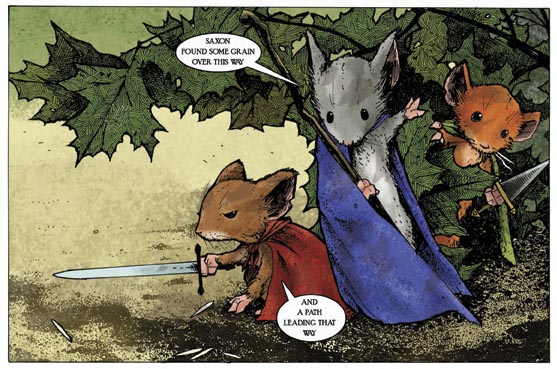
While the story might be slightly lacking in complexity, what really makes Mouse Guard stand out is its absolutely beautiful art!  I'm not sure any description if mine (vibrant color, rich texturing, great small details) could really do it justice, so take a peek at a couple of panels:


While there is a fair amount of violence, it is not overdone. In fact, there were times that I was having some trouble figuring out who was injured in a given fight sequence.  This being said, I probably wouldn't recommend mouse guard for your really little ones due to its fairly realistic portrayals of battle.

Given that this is the pilot series, I can forgive the light plot--the artwork more than makes up for it.  Did I mention how good the art is?  I am now an affirmed Mouse Guard fan and can't wait to read the second volume which covers the events of winter 1152.

Thursday, September 16, 2010

The Gunslinger


I was so excited by the news this past week that a trilogy of movies (not to mention two TV series!) based on The Dark Tower novels is being produced that I ran to the bookshelf to set about rereading one of my favorite (science fiction-western-horror-fantasy) series of all time.  Not a task to be undertaken lightly since all told the series runs several thousand trade paperback pages!


The man in black fled across the desert, and the gunslinger followed.

Great first line, eh?  So begins The Gunslinger (1982), the first installment in Stephen King's epic seven book Dark Tower series.  In it we meet Roland Deschain as he travels across a desolate wasteland in pursuit of a mysterious sorceror.  This episode is only the latest trial in a life-long quest to reach his ultimate destination:  the enigmatic Dark Tower.

Roland, thin and tough as a piece of old leather, is the last surviving gunslinger. In the baronies of Roland's homeland, the gunslingers were an honorable lot and acted as a sort of peace keeper and diplomat combined into one. Under increasing pressure from malevolent forces, the gunslingers (and, indeed, civilized society itself) eventually collapsed in the wake of a monumental struggle with said forces.  Roland now stands (or more accurately, wanders) alone and has sworn a vow to seek the ultimate source of creation, the Dark Tower. This quest puts him directly at odds with the aforementioned malevolent forces who seek to destroy the tower for their own nefarious purposes.

The world which Roland inhabits is strangely reminiscent of our own and, indeed, contains many familiar elements. There are remnants of technology strewn about the desolate landscape, though Roland professes to not understand many of these devices.  Moreover, some cultural references (for instance, the song 'Hey Jude') are shared with our own world.  These elements suggest that the setting of The Gunslinger is a strange sort of parallel universe or perhaps lies somewhere in the distant  future of our own reality.  Roland claims that his world has "moved on" and hints that this might be caused by straying away from the ancient ways of magic. The odd incongruities between Roland's world and our own set up a kind of disoriented feeling in the reader and nicely enhance the overall mood of the novel.

The Gunslinger recounts Roland's pursuit of Walter, the mysterious man in black (though you may know him as Randall Flagg from The Stand), across the nameless desert.  Along the way he encounters a number of situations that reveal themselves to be traps placed in his way by Walter to test his resolve.  In one encounter, the town of Tull is whipped into a religious frenzy and attempts to lynch Roland.  The townspeople ultimately learn what it is like to be on Roland's bad side (i.e. at the end of his gun--he doesn't have the title gunslinger for nothing).  Roland survives the tests, though not without some serious psychological pain.  Not surprisingly, the climax of the novel comes when Roland does, in fact, catch up to Walter.  Instead of a titanic showdown, some serious philosophizing ensues, predictions about the future are made, and Roland is left alone next to a great sea to ponder how to proceed with his quest.  [PLEASE NOTE:  I'm intentionally glossing over the plot here...I don't want to reveal too much.]

It was interesting to reread this novel after gaining some perspective by reading the rest of the series.  The novel was genuinely more enjoyable.  In particular, there is a fairly stark contrast between the Roland of The Gunslinger and the Roland presented in the later novels.  In this novel, he seems to be fairly flat and nearly void of emotion (at least on the surface), and his actions in The Gunslinger certainly reinforce this view.  It takes some time for the reader to become sympathetic to Roland's cause.  After my initial reading of the book, I was fairly unenthusiastic about continuing to follow what, at the time, seemed a flawed, unlikable character.  It is not until such time that his ka-tet has been formed that the true character of Roland is revealed (and after the events chronicled in Wizard and Glass, I don't think anyone in their right mind could not help but sympathize with Roland).

Remember that The Gunslinger servers as an introduction to the Dark Tower mythos and really only begins to scratch its surface.  The novel is carefully constructed to lay the groundwork for the epic story that follows in the later novels.  Taken on its own, I would call it only a passable effort for a novel--there are intriguing parts but not a fabulously enjoyable read (hence the mediocre hamster number).  When viewed in the context of  the rest of the Dark Tower story, however, it is a fitting start to a truly grand (science fiction-western-horror-fantasy) adventure!

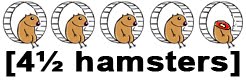
[I finally got around to creating a graphic to indicate half steps in the hamster rating scale.  Please do not be alarmed--I want to state categorically that I do not condone violence toward hamsters!]

Thursday, June 24, 2010

Lisey's Story


The author of Lisey's Story (2006) needs no introduction, so I'm going to dispense with that.  Unlike many hardcore King fans, I prefer his recent more fantastical work over his earlier novels that tended toward classic horror tales.  I really loved Duma Key (reviewed here on the blog), the novel that followed Lisey's Story and had read that the two novels together deal heavily with King's thoughts on marriage and divorce.  Note:  I listened to this as an audiobook.

The story recounts events over the course of several days in the life of Lisey Landon, wife of the award-winning novelist Scott Landon.  As the novel opens, Lisey is settling down to go through her late husband's papers two years after his death before donating them to a public collection.  A series of events causes Lisey to recall memories and events in Scott Landon's life that she had apparently been repressing for many years.  These are presented to the reader as a series of flashback chapters scattered throughout the novel and often coincide with key events in the Landon's marriage.

It is in these portions of the book where the real story of the novel takes place.  We learn the tragic upbringing of Scott Landon at the hands of his father who is held in the grips of a serious mental illness.  He is forced to take refuge by traveling to a fantastical land he names "Boo'ya Moon."  This location becomes central to Lisey in the present day, as she is slowly drawn by clues left by Scott into Boo'ya Moon in a desperate attempt to save her own sister from mental illness.  

I must say that I almost didn't make it through the first part of the book for a couple of reasons.  First, it took quite some time to build the groundwork so that the novel's actual plot could get underway.  For instance, there was an extensive flashback toward the beginning of the book that I was unable to put into context until much later in the novel.  The ultimately left me feeling fairly uninterested in what was going on until about halfway into the book.  To compound my confusion, Scott and Lisey share a language between themselves.  The novel is peppered with phrases such as "bool," "smucking," "SOWISA," and "strap it on."   I suppose this speaks to the closeness and intimacy of their marriage, but it adds another layer of complexity to a fairly intricate plot.  Plus, I honestly found the made-up language annoying.

Ultimately, the novel pulls itself together toward the latter quarter of the book and manages to redeem itself somewhat (I was going to give it a solid two hamster rating until near the end).  If you had to choose one King book to read, I wouldn't recommend this one.  On the other hand, if you a die hard King fan and can't get enough, Lisey's Story does a passable job of satisfy the craving.

Friday, April 2, 2010

The Little Country


For some reason, I always get irrationally excited when I read the quotes on the backs of books.  They get me really pumped about reading a book--I suppose that is why book publishers put them on the covers of so many books.  Nary a book goes by without somebody proclaiming it is the bee's knees, the best thing since sliced bread, or some such sentiment.  Well, the quotes on the back of The Little Country were in this vein, with high-caliber authors like Orson Scott Card, Greg Bear, and Gordon R. Dickson saying that with this novel de Lint was raising the bar for fantasy writing (or something along those lines).  When, o when, am I going to realize that those quotes are just marketing ploys?

The Little Country (1991) is a mythic fantasy novel set in Mousehole, a small village in Cornwall, England in contemporary times.  The story revolves around a mysterious book that is discovered by Janey Little, a folk musician by trade, in her grandfather's (known for some inexplicable reason as 'The Gaffer') attic.  The book, a one-of-a-kind edition of an unpublished story, was written by a deceased family friend, William Dunthorn (an author of some renown), and placed in The Gaffer's care to guard.  Over the years, various parties have shown some interest in obtaining the book, though The Gaffer has always written the attention off as people trying to make a buck off his dead friend.

As Janey begins to read the book, all sorts of odd things begin to happen.  Her old boyfriend shows up unexpectedly in the village after a long departure following their breakup.  An American woman with unknown motives begins to poke  around Cornwall.  A reporter from Rolling Stone magazine shows up for an unannounced interview with Janey Little.  We eventually come to discover that an ancient magic is stirring (*gasp*!), and it is up to Janey and her companions to guard its secret from outside forces who would put it to nefarious purposes.

Intervening chapters tell the story that unfolds in the Dunthorn book as read by Janey Little.  These detail the adventures of Jodi, a local girl who is captured by an old widow rumored to be a witch.  Her escape and subsequent marshaling of Mousehole townfolk against the widow unfold alongside the "main" story of Janey Little.  While the story-within-a-story idea is an interesting narrative technique, it was not clear to me that these chapters actually told the Dunthorn book's story until near the end of the novel.  On the other hand, maybe I'm just slow...?

I found the first half of the book to be almost excruciatingly boring.  Yes, the characters of Janey and her gang are well set up, but there is little in the way of action.  The parallel story with Jodi was the only thing that kept me going.  A major plot point revolves around a simple misunderstanding between Janey and her ex-flame that would have been cleared up in minutes by any normal adult.  Instead, it just leads to all sorts of melodrama.

A positive comment:  the setting of the novel is extremely well realized.  Cornwall, with its connection to the ocean and links to the Celtic past, provides the perfect setting for a magical world to intersect with ours.  De Lint obviously has a love of this country, and he writes about the land very well.

I was going to give the book a flat two hamsters, but the last third of the book improved by quite a bit.  In the end, I'll score it a strong two and a half hamsters (I really need to find a graphic to add the half hamsters in!).  Without doubt, there is a subset of readers out there that would probably find The Little Country to be a great read, but I'm afraid I'm just not in that group! You can quote me on that.

Tuesday, December 15, 2009

A Clash of Kings


A Clash of Kings is the second installment in 'A Song of Ice and Fire' by George R. R. Martin.  Like the first book, I listened to this one as an audiobook while working in the lab.  The reading by British actor Roy Dotrice is really top notch!

The book picks up where the last volume ended.  We are once again embroiled in the great wars that rage in the land of Westeros.  No fewer than four kings are struggling for control of the Seven Kingdoms:  Robb Stark (son of Eddard and King of the North), Joffrey Lannister (bastard son of Robert the Usurper), Stannis Baratheon (enthralled brother of Robert the Usurper) and Renly Baratheon (Stannis' younger brother).  As in the first novel, the point of view changes between figures surrounding the men vying for power.

The book concludes with a climactic battle at King's Landing for control of the Iron Throne.  I kept thinking that finally the devious Lannisters were going to get what was coming to them, but the 'wildfire' defenses put in place by Tyrion Lannister (and the forces marshaled by his father Tywin) are too much for Stannis Baratheon to overcome.  In the end, the Lannisters retain control of the throne, though Tyrion Lannister lies on the verge of death from a mortal wound suffered during the battle.

The other major plot point is the attempt by Theon Greyjoy to insert himself into the picture by capturing Winterfell, the bastion of the Stark family.  The main host of Starks left in the North (most of the Stark knights and bannermen are fighting in the South) converge on the castle to reclaim it and give Greyjoy his due justice.  At the last moment they are tricked by House Bolton and decimated.  These would-be saviors of Greyjoy betray him in the end and raze Winterfell to the ground.  I'm not really sure where this thread of plot will lead.

I find that Tyrion Lannister is a rather likeable character.  He seems to be the only one in the Lannister bunch that has any sort of moral compass.  Now that his father has shown up, I fear that the more overbearing members of his family are going to marginalize him.  I'm hoping that this sort of treatment will remove his blinders, and he will finally realize that he is fighting for the side of wrong.  Perhaps in the next book he will come over to join the Starks?  I'm probably asking too much.

I'm definitely enjoying the series.  As I said in my review of the first novel, it is definitely a fresh take on a rather tired fantasy genre.  I'm looking forward to immediately starting the third installment, A Storm of Swords.

Monday, November 2, 2009

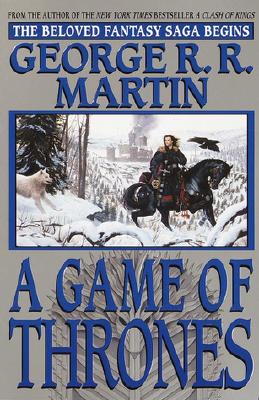
A Game of Thrones


I've taken to listening to long fantasy epics while working in lab on the microscope--it is a great way to maintain a high entertainment level while actually getting work done!

I attempted to read a paper copy of A Game of Thrones a while back (at least I know I read the beginning) and, as I recalled, didn't find it extremely compelling.  I now suspect that was because I didn't get fully into the plot and was bogged down by the large number of characters and place names in the novel.  I think that the audiobook helped in this respect as the excellent narration (by Roy Doltrice) gave each character their own voice qualities such that it was easier to tell them apart.

The novel centers around House Stark, the family that has ruled the North for thousands of years from their seat at Winterfell castle.  War is once again upon the land during the weak rule of the once strong King Robert Barratheon.  Following his death, different factions in the land are playing at "the game of thrones" to consolidate their own power in the Seven Kingdoms.

Each chapter is told from the viewpoint of a different major character (most of them from House Stark).  This type of narrative is particularly effective and moves the pace of the action along nicely--I was rarely left hanging wondering what was happening to one character during one of these shifts in narrative.

I definitely tend to more Tolkein-like fantasy with magic, different races, etc.  A Game of Thrones definitely did not follow many of these conventions, instead tending to mimic the customs and culture of medieval Europe.  There has been little mention of races other than humans and no magic in the conventional sense.  It is definitely a different take on a fantasy setting (dare I say refreshing?), distancing itself from the more formulaic world/settings of the Wheel of TimeThe Sword of Truth, etc.

The novel opens with a curious incident in the far North, beyond the Wall, where a party of rangers is attacked by a strange humanoid creature (what can only be one of the 'Others').  This somewhat mythical race (maybe human, maybe not) is referred to throughout the book but we never get another solid look at them.  I hope that this plot line is expanded upon in subsequent installments of the series (there are apparently 7 books planned, of which there are currently 4 published).