Showing posts with label malazan. Show all posts
Monday, February 7, 2011
Memories of Ice
Memories of Ice (2001) is the third volume in the Malazan Book of the Fallen (MBotF) series. It is a serious whopper of a book with the paperback weighing in at a cool 1,187 pages. While not as good as its predecessor, MoI carries the main plotline forward in an interesting, if not completely gripping, manner.
MoI is the direct sequel to the first novel in the series, Gardens of the Moon, and the events within happen concurrently with those of Deadhouse Gates. See? It is already getting complicated, and I haven't even tried to summarize the plot yet.
We once again join the fellows of Whiskeyjack's company in the Malazan army which now finds itself threatened by the Pannion Domin, a powerful army rising out of the south. It soon becomes clear that there is something altogether sinister with the power behind the Pannion Domin. As this tide sweeps ever closer to the Malazans, a desperate plan is hatched to forge an alliance with old enemies.
The majority of the novel describes the desperate struggle to hold Capustan from the Domin and is told from both the perspective of soldiers trapped within the city and the Malazan army racing across the continent to relieve the seige. The climactic struggle for Capustan is really the high watermark of the novel--I've not read many fictional battle scenes described as vividly (or as well) as here. Erickson does an excellent job of keeping the mood tense and desperate throughout this section of the novel.
Of course, it wouldn't be the MBotF if this action on the prime material plane wasn't part of some grand, cosmic scheming of the gods. There is plenty of divine, magical intrigue to add to the plot arc that has been building since the first novel.
Memories of Ice definitely has its high points, but, on the whole, I prefer its predecessor more. The climactic battle scenes were epic, but, boy, did it take a lot of slogging to get there. Maybe I would have enjoyed it more if it had been broken up into two shorter novels (in fact, there was a perfect place to do just that). Nevertheless, I still find myself intrigued by the Malazan world and will read on to (hopefully) find some resolution to the main storyline.
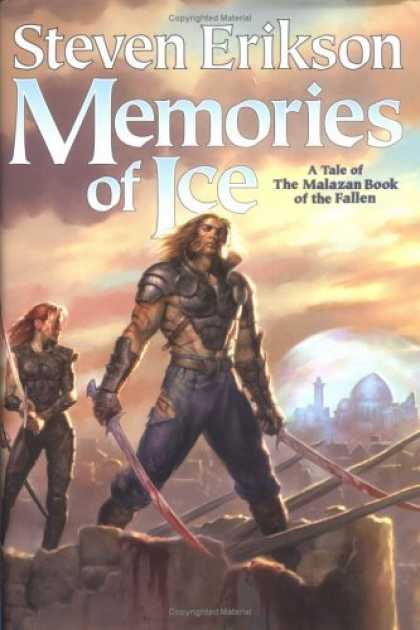
Also: please don't get me started on the cover art--I would rank it as one of the cheeziest covers I've ever seen. I was actively embarrassed to be seen reading the book in public.
Wednesday, January 5, 2011
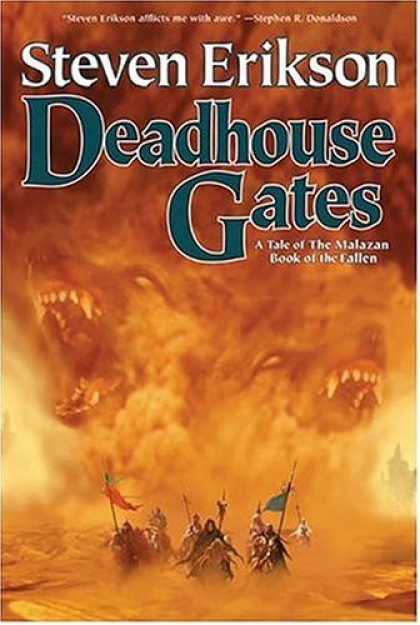
Deadhouse Gates
[Alright, the time has come for me to bite the bullet and write this review of the second book in the Malazan Book of the Fallen series. I finished it way back before Thanksgiving and have put off reviewing it...I seem to have this reluctance every time i read one of these fantasies that span several novels.]
Deadhouse Gates (2000) generally continues the story introduced in the first novel of the series, Gardens of the Moon (GotM). Though the action in this novel takes place on another continent, a few of the characters from GotM are crucial participants in events as they unfold in DG.
To distill an extremely complex story down to its essentials, we follow an apocalyptic uprising known as The Whirlwind foretold by an ancient prophecy (what fantasy epic would be complete without an ancient prophecy?). We learn the unlikely circumstances behind its leader and some of her motivations for ridding the world of the Malazan Empire. Much of the novel follows a garrison of Malazan soldiers under the command of a foreign warrior across the desert in their desperate attempt to stave off the rebel force. There are some fantastic battle scenes where the Malazans use some clever tactics to hold off the vastly numerically superior Whirlwind force. This being the Malazan universe, there are also a fair number of powerful beings (be they gods or merely so-called "Ascendant" mortals) meddling around in everybody's affairs.
Astute followers of my blog (all two of you) will recall that while I was quite intrigued by the Malazan universe, I had some gripes with Gardens of the Moon. The most notable being that the reader is thrown head first into an extremely complex plot with close to no context for anything that is happening. Well, I'm glad to say that DG was much easier to follow than its predecessor. Not only did I have a better grasp of the Malazan world and magic this time around, but Erikson does a more skillful job of building the plot. The action slowly builds to high tension and is then rips loose near the end of the novel where there are some really memorable scenes.
All-in-all, Deadhouse Gates is a better novel than its predecessor. Seeing as how I'm currently reading the fourth book in the Malazan Book of the Fallen (told you I was falling behind with my reviews), I would recommend continuing the series!
Tuesday, November 2, 2010
Gardens of the Moon
I caught wind of Gardens of the Moon (1999) in a thread of recommended books over on BGG. I had not heard of it before and was surprised to see that it has garnered an almost fanatical following among some internet circles (the kind that argue over whether GRRM's ASOIAF or Tolkein's LOR is the best series EVAR!). The internet fanboys promised world building on a grand scale, an intricate plot, lots of epic battle scenes, complex magic system, etc. Basically all the things that make D&D-raised fantasy readers drool over. Well, it is certainly epic enough--as it turns out, GotM is the first installment in a 10-volume series known as 'The Malazan Book of the Fallen' (which has thankfully been completed as of this writing...always something to worry about when embarking on reading an epic fantasy series). While the novel does deliver on most of these promises, it does so in an almost infuriatingly convoluted way.
GotM takes place in a world dominated by the Malazan Empire, a human government attempting to conquer anything and everything it can get its hands on. I certainly wouldn't want to spend much time in this world--everything is dark and gritty with evidence of war and despair everywhere. Perhaps the most striking feature of the Malazan universe and, indeed, what sets it apart from other fantasy series, is the complexity and importance of magic which is controlled through an enigmatic construct known as a 'warren.' In addition to different human factions, there are a number of non-human (but also non-elf/dwarf/[insert conventional fantasy race here]) races running around in the background controlling different and altogether more ancient kinds of sorcery. Did I also mention that there are gods battling with one another to control the action? Perhaps you are getting the picture here. Erikson, an archaeologist and anthropologist by training, has created a complex universe that, while well-realized, is somewhat difficult to approach (much less internalize fully) at the outset.
Couple this fantasy setting with a plot that matches it in complexity. My attempt at a complete summary would frankly be laughable given my level of confusion throughout most of the novel. Basically, the Malazan empire has come up against some stiff resistance from a mysterious group of warrior mages that ally themselves with the remaining free cities. In addition, the Malazans face internal dangers from an army that is growing increasingly loyal to its commander. The action centers around the struggle within Darujhistan, one of the last holdouts against the empire, and how the many different factions (soldiers, mages, residents of the city, gods) try to manipulate events, and are, in turn, manipulated by each other.
I've not been so seriously challenged reading what I thought was a light, "for-fun" read in a long time. The causes for this are manifold, but most prominent is the unusual plot structure employed by Erikson to tell his story. We are literally thrown head first into the middle of a complex plot with no context to the characters, their actions, their relation to one another, etc. This is not to say that there isn't a lot of background information given. Quite the opposite is true--there are dozens of characters, locations, and past events thrown at you. Right up until the end of the novel, I never seemed to grasp enough information to satisfy me that I actually understand what was happening at any given time. The best comparison I can make is to the TV show Lost...understanding the island's mysteries never seemed that far away if only you could get that one critical piece of information that would make everything clear. Reading the novel was certainly not a chore, but it did require some focused attention.
Despite my bafflement, GotM has whetted my appetite for more of the Malazan universe. I really (really, really) want to see how the major plot lines play out. So, perhaps GotM has done what its author intended!
Subscribe to:
Posts (Atom)