Thursday, September 16, 2010

The Gunslinger


I was so excited by the news this past week that a trilogy of movies (not to mention two TV series!) based on The Dark Tower novels is being produced that I ran to the bookshelf to set about rereading one of my favorite (science fiction-western-horror-fantasy) series of all time.  Not a task to be undertaken lightly since all told the series runs several thousand trade paperback pages!


The man in black fled across the desert, and the gunslinger followed.

Great first line, eh?  So begins The Gunslinger (1982), the first installment in Stephen King's epic seven book Dark Tower series.  In it we meet Roland Deschain as he travels across a desolate wasteland in pursuit of a mysterious sorceror.  This episode is only the latest trial in a life-long quest to reach his ultimate destination:  the enigmatic Dark Tower.

Roland, thin and tough as a piece of old leather, is the last surviving gunslinger. In the baronies of Roland's homeland, the gunslingers were an honorable lot and acted as a sort of peace keeper and diplomat combined into one. Under increasing pressure from malevolent forces, the gunslingers (and, indeed, civilized society itself) eventually collapsed in the wake of a monumental struggle with said forces.  Roland now stands (or more accurately, wanders) alone and has sworn a vow to seek the ultimate source of creation, the Dark Tower. This quest puts him directly at odds with the aforementioned malevolent forces who seek to destroy the tower for their own nefarious purposes.

The world which Roland inhabits is strangely reminiscent of our own and, indeed, contains many familiar elements. There are remnants of technology strewn about the desolate landscape, though Roland professes to not understand many of these devices.  Moreover, some cultural references (for instance, the song 'Hey Jude') are shared with our own world.  These elements suggest that the setting of The Gunslinger is a strange sort of parallel universe or perhaps lies somewhere in the distant  future of our own reality.  Roland claims that his world has "moved on" and hints that this might be caused by straying away from the ancient ways of magic. The odd incongruities between Roland's world and our own set up a kind of disoriented feeling in the reader and nicely enhance the overall mood of the novel.

The Gunslinger recounts Roland's pursuit of Walter, the mysterious man in black (though you may know him as Randall Flagg from The Stand), across the nameless desert.  Along the way he encounters a number of situations that reveal themselves to be traps placed in his way by Walter to test his resolve.  In one encounter, the town of Tull is whipped into a religious frenzy and attempts to lynch Roland.  The townspeople ultimately learn what it is like to be on Roland's bad side (i.e. at the end of his gun--he doesn't have the title gunslinger for nothing).  Roland survives the tests, though not without some serious psychological pain.  Not surprisingly, the climax of the novel comes when Roland does, in fact, catch up to Walter.  Instead of a titanic showdown, some serious philosophizing ensues, predictions about the future are made, and Roland is left alone next to a great sea to ponder how to proceed with his quest.  [PLEASE NOTE:  I'm intentionally glossing over the plot here...I don't want to reveal too much.]

It was interesting to reread this novel after gaining some perspective by reading the rest of the series.  The novel was genuinely more enjoyable.  In particular, there is a fairly stark contrast between the Roland of The Gunslinger and the Roland presented in the later novels.  In this novel, he seems to be fairly flat and nearly void of emotion (at least on the surface), and his actions in The Gunslinger certainly reinforce this view.  It takes some time for the reader to become sympathetic to Roland's cause.  After my initial reading of the book, I was fairly unenthusiastic about continuing to follow what, at the time, seemed a flawed, unlikable character.  It is not until such time that his ka-tet has been formed that the true character of Roland is revealed (and after the events chronicled in Wizard and Glass, I don't think anyone in their right mind could not help but sympathize with Roland).

Remember that The Gunslinger servers as an introduction to the Dark Tower mythos and really only begins to scratch its surface.  The novel is carefully constructed to lay the groundwork for the epic story that follows in the later novels.  Taken on its own, I would call it only a passable effort for a novel--there are intriguing parts but not a fabulously enjoyable read (hence the mediocre hamster number).  When viewed in the context of  the rest of the Dark Tower story, however, it is a fitting start to a truly grand (science fiction-western-horror-fantasy) adventure!

[I finally got around to creating a graphic to indicate half steps in the hamster rating scale.  Please do not be alarmed--I want to state categorically that I do not condone violence toward hamsters!]

Tuesday, September 7, 2010

Chung Kuo: The Middle Kingdom


Chung Kuo:  The Middle Kingdom (1989) is the first volume of David Wingrove's massive Chung Kuo science fiction series.  I read most of the series a long time ago and recently decided to revisit the novel(s).  After reading it the first time, I was fairly amazed that the series as a whole has gotten so little attention from scifi readers.  After this read, I find it to be nearly as good as I remember--not a literary novel by any means, just solid, shoot-from-the-hip adventure and intrigue.  I would rate it 3.5 hamsters if my silly system allowed me to do so!

The novel is set in a future Earth where China (or at least Chinese culture) dominates the world.  The events leading to this massive shift in world culture have not been made clear (though a prequel novel to be released soon might shed some light on how it originates).  At any rate, the continents of Earth are ruled by a council of seven T'angs, who are akin to Chinese emperors and have absolute control over the life and death of the populace.  The family of Li Shai Tung, the T'ang of Europe, is at the heart of the plot in Chung Kuo: TMK.

The entire population of Earth lives in a 300-story structure made of a super plastic material known only as Ice.  Success in Chung Kuo (which is, incidentally, the ancient name for China itself, meaning 'The Middle Kingdom') is measured by where you reside in the structure:  residents of the highest levels are those with the most power, while lowborn citizens are confined in the dirty, chaotic lower levels.  Underneath Chung Kuo lies 'The Clay', where packs of humans live feral lives at best.  The world-building in the novel is absolutely fantastic; Wingrove's Chung Kuo provides a wonderful setting in which the plot unfolds.

When we pick up the story, the T'angs are coming under increased pressure from a faction of wealthy industrialists and their political allies (known as the Dispersionists) for reforms.  As seems to be the case with just about any entrenched ruler, the T'angs seek to avoid loosening their grip on power at any cost.  They are particularly loathe to allow any sort of Western influence to work its way into society.  This conflict in ideoology eventually leads to a bitter clash known as the 'War of Two Directions' for control of Chung Kuo and, with it, the population of Earth.

The novel tells the story from the viewpoints of a number of characters as they are swept into the unfolding  struggle for power. As a result, we get a view of Chung Kuo society from the absolute top (the leaders of both factions) down to the lowest of the low (a Clay-born boy).  There are a TON of characters in the novel and a lot of them have Chinese names.  It is somewhat overwhelming at first, but the book has a handy cast of characters section to help readers keep them straight.

To be clear:  Chung Kuo: TMK  is not without its faults.  Wingrove most definitely falls prey to a good dose of Orientalism every now and then (a definition from wikipedia: preconceived archetypes that envision all "Eastern" societies as fundamentally similar to one another, and fundamentally dissimilar to "Western" societies).  Hmm...sounds a lot like the whole plot of the book, doesn't it?  While the menace was always looming close, I feel like Wingrove only grossly fell prey to it on a few occasions.  The reader will have to decide if this taints the whole novel--I don't think it does.

If you go to any book website and read reviews of Chung Kuo: TMK, you will see that much has been made about its violence.  In fact, the most strident objections are raised over one sexually explicit scene in the book that lasts for maybe five pages.  As with most anything you read on the internet, take these rather strangely impassioned reviews with a grain of salt.  Yes, the scene is explicit.  Yes, it is uncomfortable reading.  BUT:  the scene is not gratuitous and does serve a purpose.  Namely, to cement in readers' minds the evilness of the leader of the Dispersionist faction, who, up until that point, may have turned out only to be an ideological hardliner.  Who knows how many people have been scared away from reading what is a fairly good novel because of these reactionary reviews?

Despite some flaws, Chung Kuo: TMK is a great start to what can only be described as an epic science fiction series.  As I said in the introduction--if you are looking for a deep book, put down Chung Kuo immediately and pick up the likes of Hyperion instead.  Instead, if you go in expecting a well-written series with plenty of interesting characters and adventures, you won't be let down!

Tuesday, August 31, 2010

The (second) Uplift Trilogy: Review


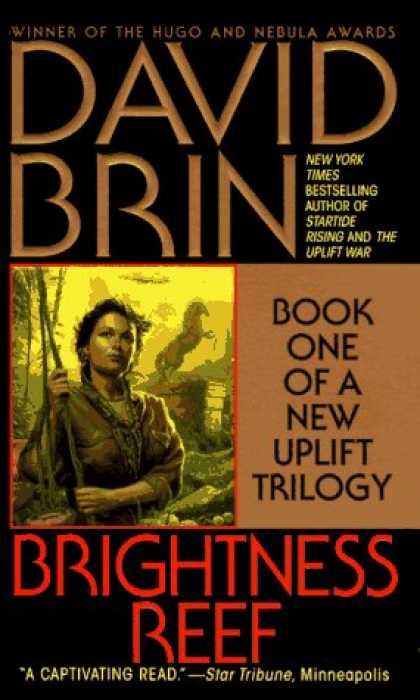
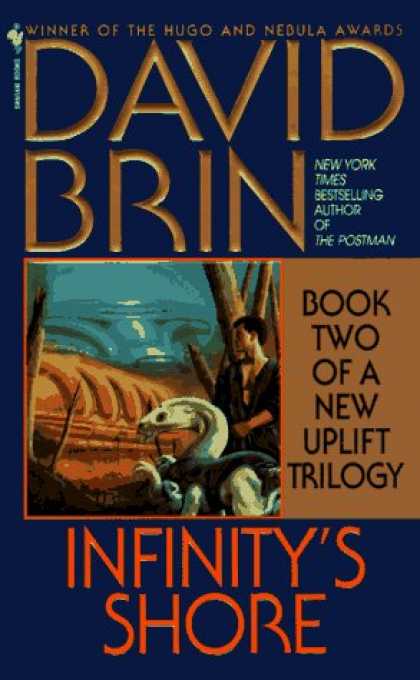
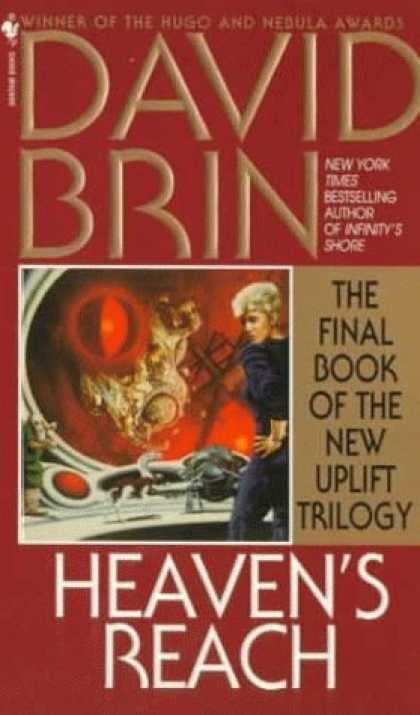
Alright, so you may have surmised from my last post that I really enjoyed reading Brin's second Uplift trilogy.  Brightness Reef (1995), Infinity's Shore (1996) and Heaven's Reach (1998) contain so many thought-provoking ideas wrapped up in an exciting plot, how could I not rate it highly?  [This is yet another example of how I need half steps in my rating system--I would give it 4.5 hamsters if I had a suitable graphic!]

First off--do you need to have read the previous Uplift novels to make sense of the story in this series?  The answer is definitely not as the essential details (particularly the events of Startide Rising [1983]) are revealed as remembrances of the characters.  But, on the other hand,  it certainly couldn't hurt.  I read the first Uplift books many years ago and had only a vague remembrance of the plot, and I did just fine.  The better question is why haven't you read them yet anyway?

The story opens on Jijo, a backwoods planet that has been declared fallow by the galactic Institute of Migration so that its ecosystem might have time to recover after use by its former inhabitants.  Here we find a society forged by members of six species (of which humans are one) who have independently colonized the planet for different reasons but with the same intent--to drop out of galactic society.  Unauthorized use of the planet is, of course, highly illegal in the eyes of galactic law.  As a result, the colonists have forsaken galactic technology and strive to leave no mark upon Jijo that might give them away from space. These circumstances have led to the development of a uniquely Jijoan religion based around the hope of regressing to a pre-sentient state by fostering a more primitive lifestyle.  If this state can be achieved, perhaps the Jijoans will be discovered by a new patron species and uplifted to a more perfect state.  This concept permeates every aspect of Jijoan culture.

Despite a somewhat fractious pass, the sooner species have forged peaceful bonds, united in their striving for redemption in the form of devolution.  This fairly idyllic life is shattered when a starship descends to the planet surface in the middle of an annual gathering of the six species.  It is soon discovered that these newcomers are not agents of the galactic government, but are, instead, criminals looking to raid fallow planets for species that may be ready for the uplift process.  This revelation sparks a fierce debate among different Jijoan factions, and the first half of the trilogy deals with the upheaval caused by the conflict.

Unbeknownst to just about everyone on the planet, two other spaceships have also arrived on Jijo.  The Streaker, from Earth and crewed by uplifted dolphins, has been on the run from most of the galaxy for several years following a spectacular discovery with implications for the identity of the revered Progenitors (detailed in Startide Rising).  The second ship, from the feared Jophur clan, has arrived in pursuit of the Streaker.  Streaker's predicament slowly transitions to the fore of the plot and drives the action for the remainder of series when a group of Jijoans are caught up in the trouble and forced to leave the planet.  It turns out that the Streaker has a pivotal role to play in deciding the fate of not only humankind but that of galactic civilization at large!

The characterization of the dolphins aboard Streaker is definitely one of the high points of the novels.  They are imbued with just the right blend of playfulness and intelligence.  This often comes across in the haiku verse (named trinary) that the neofins use to communicate with one another aboard the Streaker.  Also enjoyable was our first experience with hydrogen breathers, the second major order of life in the galaxy.  The idea of a wholly separate division of life above the species level really grabbed me when I read the first Uplift books, and I was hoping it would get explored further in this trilogy!

I'm not sure that I've done the novels justice above, but I hope it comes across that I thoroughly enjoyed this trilogy for both its bold ideas and wonderful writing.  This will teach me to combine three reviews into one next time I read a trilogy...it turns out to be harder than I thought!

Thursday, August 26, 2010

The (second) Uplift Trilogy: Introduction


No, I haven't abandoned posting to the blog!  After nearly a month, I'm back to review not one but three novels: David Brin's "new" or "second" or whatever-you-want-to-call-it Uplift trilogy. Unlike the previous three  novels set in the Uplift universe, Brightness Reef (1995), Infinity's Shore (1996) and Heaven's Reach (1998) share a continuous plot from book to book.  For this reason, after finishing the first novel, I decided to review the series as a whole.  To make this a less monumental task, I'm going to break the review into two parts:  an introduction to the Uplift universe and a review of the three novels themselves.

Are you looking for a literary universe with mind bogglingly cool ideas?  Well, David Brin has more of them than you can shake a stick at in his Uplift novels!  I really don't even know where to begin.  The essential feature of his universe revolves around the idea that more advanced starfaring civilizations "uplift" presapient species by directing the final stages of their evolution into an intelligent species.  This is, of course, done through genetic and social manipulation over the course of many years.  Once uplifted, the species is considered a member of galactic civilization in its own right but is indebted to and remains part of the "clan" of their patrons.

It is commonly believed that a mysterious race known as The Progenitors instituted the Uplift process up to a billion years ago before disappearing without a trace.  This has led to the development of a number of different belief systems based around the fate of the Progenitors, and, indeed, the ultimate fate of all galactic species.  In galactic society, the purpose and fate of individuals is rarely considered important (or even considered at all).

Humans are relative newcomers onto the galactic scene, having made contact a few hundred years prior to most of the events in the Uplift novels.  They are one of the rare species (known as wolflings) who have managed to bootstrap themselves into the stars without the help of a patron species.  The lack of patrons to guide and protect humans as they establish themselves puts them in a very rough spot among the rigid caste system that dominates every aspect of galactic life.   Luckily, humans had already began the process of uplifting chimpanzees and bottlenose dolphins before making contact with galactic civilization.  This gives them a little more cred than the few other wolfling species have had in the past.

In the Uplift universe, life in the linked galaxies is divided into several orders of life.  Not only are there oxygen breathing species, but also those that utilize hydrogen to sustain life (I won't comment on the biological feasibility of this concept).  Suffice it to say that the two groups don't get along well.  The Institute of Migration, an arm of galactic bureaucracy, coordinates oxy interactions with hydros, even going so far as ceding them whole swathes of galaxies to avoid conflict.  While hydros were tangentially mentioned in the first three Uplift novels, they play a far larger role in the second series of novels.  In addition to the two organic forms of life, there are a number of other orders that oxygen species have so far had limited interactions with:  machine, quantum, memetic, etc.

The age of galactic civilization is staggering, with at least a billion years of history going back to the Progenitors.  Starfaring civilizations have, therefore, been gathering and refining their knowledge for many hundreds of millions of years, collecting it in a repository known as the Galactic Library.  This knowledge is communicated using a set of standardized languages that have been refined over the eons to transmit information as efficiently as possible between species with vastly different auditory, visual, and vocal organs.  The languages vary from a series of pops and clicks that most any species produce (with tools if necessary) to higher level languages more akin to what we humans would call "talking."  Because of these highly ordered information conventions, most species take the opinion that "everything that is done has been done before," thereby reinforcing the conservative nature of society as a whole.  Needless to say, this conflicts with indomitable human nature and becomes one of the central themes of the Uplift novels.

Are you getting the drift here?  Brin has created a rich and vibrant universe!  I could list ten other provocative ideas he describes without even trying.  The Uplift novels have a bit of everything--hard biology and physics with a large dose of sociology, anthropology (or species-pology?) and psychology thrown in.  I highly recommend all six Uplift novels--they are both well written and thought-provoking and rank among the best that science fiction has to offer!

[Next time:  an actual review of the second Uplift trilogy.]

Thursday, July 22, 2010

A Morbid Taste for Bones


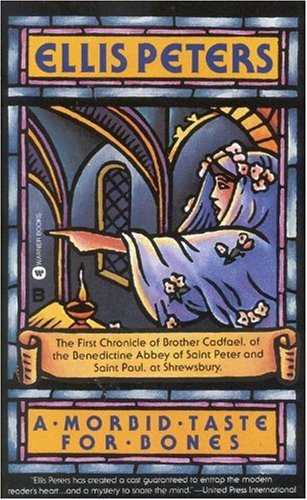
A Morbid Taste For Bones (1977) is the first in the Brother Cadfael series of mystery novels set in 12th century England by Ellis Peters (of which there are 21 books).  I have my mom to thank for introducing me to Brother Cadfael's adventures many years ago.  I'd like to reread m .  Note:  I listened to this as an audiobook.

The main character, the Welshman Brother Cadfael, is an unusual example of a Benedictine monk who lives in the Shropshire village of Shrewsbury.  I say unusual because he has come to his monks' habit late in life after having spent many years in the Holy Land as a Crusader in his younger years.  His rich life experiences give him an eye for seeing people and events in a different light than most of his cloistered brothers.

As the novel opens, Colambanus, one of Cadfael's brothers is overcome at Mass by a fit of religious fervor and falls into a coma.  A brother standing vigil in the night over the stricken brother is visited by a mysterious personage who instructs him to bring Columbanus to the Well of St. Winefride in Northern Wales.  By no coincidence, St. Winefride has been shortlisted as a saint whose relics the Abbey (or more specifically, the overbearing Prior Robert) has an interest in acquiring.  Getting a hold of a saint's relics was a big deal in medieval times, when housing such a religious relic would guarantee a constant stream of pilgrims (and revenue) for a church .

Columbanus is miraculously cured at the well and insists St. Winefride herself appeared to him and expressed a desire to be moved to a place more hospitable to pilgrims.  The majority of the book revolves around a journey undertaken by the monks to translate her remains from the village of Gwytherin to the Abbey of Saint Peter and Saint Paul in Shrewsbury.

Needless to say, the residents of Gwytherin are none to happy with the sudden interest taken in their Welsh patroness by English monks.  Despite having the permission and authority of both the church and local lord, the village is reluctant to allow the brothers to remove St. Winefride's body.  At a village-wide meeting, an influential landowner, Rhisiart, clashes with Prior Robert and cements the village's intention to deny the monks their prize.  The following day, Rhisiart is found foully murdered by an arrow through the chest.  Being Welsh himself, Cadfael feels especially close to the involved parties, and he undertakes a full investigation of Rhisiart's murder.  Using his uncanny ability to read people, Brother Cadfael unravels the mystery after several twists and turns.

Ah - but does St. Winefride ever make it to Shrewsbury?  You'll have to read to find out!

I thoroughly enjoyed the novel.  Brother Cadfael's character is delightfully written.  He is both irreverent and witty at times -two traits one does not usually associate with a medieval monk.  He's the kind of guy you'd love to sit down and have a drink with.  I look forward reading about his further adventures!