Wednesday, November 16, 2011

Long time, no entry...Part I

Well, unfortunately (or fortunately, depending on how you look at it), real life has once again caught up with me, and I haven't had time to properly review any books.  Never fear! I have been steadily reading away as usual, keeping track of everything over at Goodreads!  Since it is obvious that I stand no chance of ever catching up with my back log of books to review, I thought I'd go ahead and post a more succinct summary of my recent reads in a multi-part series.  So...without any further ado:

The Windup Girl by Paolo Bacigalupi (2009)
Co-winner of the 2010 Hugo Award (tied with The City & The City, previously reviewed by yours truly here).  The novel takes place in a near-future where energy sources have become severely depleted, forcing massive changes on society.  Food production is completely controlled by mega-corporations who engineer plants to suit their clients' needs.  An extremely good book with a lot of thought-provoking ideas about where humanity is heading if we continue on with our unsustainable rate of consumption. [5 hamsters]


The Brothers K by David James Duncan (1992)
This book follows the ups and downs of a midwestern family whose four sons come of age in the '50s and '60s.  Narrated by the youngest son, it focuses on the father's minor league baseball career and how his brothers deal very differently with the reality of war.  Laced throughout is some of the best writing about families that I've ever read--it really captures the love and dynamics of family in an unforgettable way. [4.5 hamsters]


The Hunger Games by Suzanne Collins (2008)
Is there anyone who doesn't know what The Hunger Games is about?  In a post-apocalyptic world, a central government holds the Hunger Games, where teenagers from different districts are pitted against one another in a televised battle from which there is only one survivor.  Fantastic premise, though the main plot is strongly reminiscent of Stephen King's The Long Walk (see my review here).  This is a heck of a good book--one of those that I simply couldn't read fast enough.  Highly, highly recommended.  [5 hamsters]
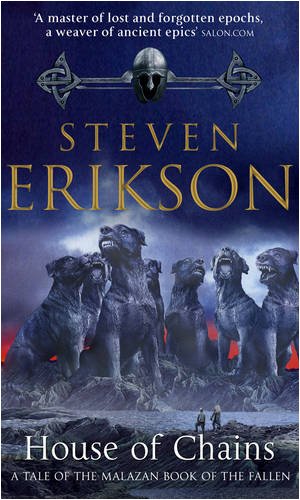

House of Chains by Stephen Erikson (2002)
This is the fourth book in the Malazan Book of the Fallen series (reviews of previous volumes here).  These novels continue to be somewhat convoluted and a challenge to piece together, but they also continue to capture my fascination.  House of Chains, a direct sequel to Deadhouse Gates, was a little slower moving than its predecessors, but carried the story forward nicely once everything got going.  [3.5 hamsters]


The Broken Wheel by David Wingrove (1990)
The second volume to the Chung Kuo series (first volume reviewed here).  No surprises in this one--nothing deep but a fast paced story in a well-realized future world.  Wingrove is in the process of reissuing an expanded 20-volume (if you can believe it) set of Chung Kuo books which I'm pretty excited about checking out in the future since it fills in some of the gaps in the original series.  [3.5 hamsters]
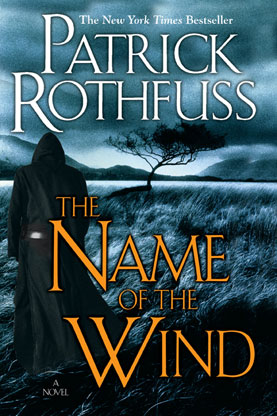


The Name of the Wind by Patrick Rothfuss (2007)
There was a lot of buzz around this novel on the nets, so I thought I'd check out Rothfuss's debut novel.  It is a really interesting book despite employing more than a few fantasy cliches.  The best description I can give it sells it short but here goes anyway: a mature version of Harry Potter.  Not quite fair, but the comparison is inevitable.  A well written book, it has one of the most logical, developed systems of magic of any novel I've come across.  There aren't people going around pointing wands at each other and saying cute phrases to wield magic; instead, a caster acts as more of a conduit for energies from the natural world.  Great stuff! [4.5 hamsters]

Stay tuned! More updates to come soon!

Monday, August 8, 2011

A Dance With Dragons


Never fear, dear reader, I've not forgotten about the blog but, rather, have been attending to more important things in real life (like earning a Ph.D.).  As it happens, it takes one of the biggest publishing events in geekdom to draw me out of my silence.  So, without further ado:

[Don't worry, I'm not going to include any real spoilers in the review.]

Unless you've been living under a rock lately, you probably know about George R.R. Martin's epic fantasy series, A Song of Ice and Fire (ASOIAF).  The HBO series based on the first novel in the series, A Game of Thrones, has been hugely successful and drawn people to ASOIAF that I otherwise would never have expected to show any interest.  My Goodreads and Facebook feeds have lit up in recent weeks with people talking about ASOIAF.  We're talking females who I went to high school here, for goodness sakes.  The powers of HBO are truly mind boggling.

Well, A Dance With Dragons is the fifth novel in ASOIAF.  It has been in the works for six, count 'em, SIX years.  Everyone (read:  geeks on the internet) was getting a bit worried about GRRM's ability to pull this one off after his long delay.  Also, he is not exactly a young man (or a particularly healthy-looking man for that matter), so this break was (is?) possibly threatening the completion of the series (let's not forget the tragic death of Robert Jordan).  Well, I'm happy to say that GRRM's latest novel is a solid effort; GRRM has lost none of his flair with the quill.

So:  Is there action? Adventure? Intrigue? Violence? Sex?  Fire-breathing dragons?  The answer to all these is, happily, YES!  Do we meet up with our favorite characters so cruelly abandoned in A Feast for Crows?  Yes!  Are there any events that are going to rock the foundations of ASOIAF?  I guess so (note the lack of enthusiasm; see below).

So what gives?  Why the 3.5 hamster rating?  While the novel has all these things and more, you will be forced to meander with each character across Westeros and the Free Cities many times over in between encounters of substance.  No form of transportation has been left out:  wagon, river boat, horse, sea galleon, and, most importantly, good ol' feet.  A Dance With Dragons cries out for a good editor--I could cut several hundred pages out of the book without raising a sweat and there would more than ample room to tell the same story.

This brings me to my biggest problem with the novel.  Simply put:  the novel spectacularly fails to push the main plot forward.  Characters are shuttled around the world, some things happen, but the threads of main plot are coming together so achingly slowly (or in several cases not at all), at this rate it is going to take at least 15 more books to reach some semblance of a conclusion to all this.

All this being said, the novel is a good read, certainly better than A Feast for Crows.  I look forward with great anticipation to the next book in the series, so I guess on that account, A Dance With Dragons is a spectacular success!

Monday, June 13, 2011

The Company


The Company (2002) is a huge door-stopper of a book (nearly 900 pages) that chronicles the Cold War as seen through the lens of the Central Intelligence Agency (CIA).  Mixing fact and fiction, the novel is a sweeping Clavell-style epic that begins with the end of World War 2 and continues through the collapse of the Soviet Union.

The Company (as the CIA is more colloquially known) revolves around a group of men who are recruited to join the newly minted agency after their graduation in the early 1950s.  They are soon thrown into the wild west that was post-war Europe and cut their teeth running agents and coordinating resistance within the Eastern bloc.  Soon the cohort becomes involved in several of the major covert operations that would come to characterize the West's struggle against the Soviet Union (e.g. the failed Bay of Pigs invasion).  These "on the ground" action sequences are some of the most compelling in the novel.  Littell portrays actual historic personalities alongside his fictional characters, and the two are blended together seamlessly.

Woven throughout the novel is a plot hatched by Starik, a sinister Soviet spymaster, to bring about the downfall of his glavny protivnik (principal adversary), America.  Taking the long view, Starik quietly embeds a double agent, SASHA, within the CIA and dangles tantalizing clues as to his identity in front of the Americans for decades in the hopes of creating a paralyzing climate of paranoia.  This plot arc, based on the career of the notorious spy-hunter James Jesus Angleton (featured prominently in The Company), provides continuity and links each major section of the novel together.  The climax of the novel comes as the fictional identity of SASHA is finally revealed (the real SASHA was never identified...if he even existed in the first place).

With a few notable exceptions, many of the fictional characters, though having well-developed personal stories, are fairly wooden.  The author also takes some liberties with his unflattering portrayal of real characters--Littell's Robert Kennedy is a rabid dog, and his Ronald Reagan a lost sheep.  Thankfully, these quibbles are fairly minor and the gripping plot quickly carries the reader past them.  Overall, The Company succeeds magnificently in its attempt to offer a panoramic look at the Cold War and the culture within the CIA during one of the more turbulent periods of American history.

Wednesday, May 25, 2011

Never Let Me Go


I'm the first to admit that I easily get swept up by the bandwagon when something big rolls around.  I take almost giddy delight in reading reviewer's quotes on the back of nearly every book I read.  So, when on the cover of Kazuo Ishiguro's Never Let Me Go (2005), Time magazine declares the book to be "the best novel of the decade," I go into it with fairly high expectations.  Moreover, Never Let Me Go is held up as a stirring expression of the moral disquietude that often comes hand-in-hand with advances in biomedical science, a field which is near and dear to my own heart.

The story itself revolves around a three children who are raised at Hailsham, a boarding school nestled in the English countryside.  Kathy H., the narrator of the novel, provides a window into Hailsham through her recollections of day-to-day life with her friends.  In the course of these vignettes, it becomes clear that Hailsham is no ordinary school.  The children, while seemingly well cared-for by their guardians, are not taught the skills necessary to lead an independent life and, arguably more damaging to them, lack any nurturing emotional connections save those they clumsily forge amongst themselves.

As they grow older, the children slowly come to the realization of exactly who and what they are.  As it turns out, they are clones being raised to provide organs needed by others in the outside world.  At some point in their lives, each of them will become a donor and eventually, unable to give any more, will "complete."  There is no great moment of realization here.  Instead, the children catch snippets of information about what their future holds here and there as they grow older, and are, remarkably, almost wholly unphased by the revelation.

While Kathy spends a good deal of time trying to understand how they become aware of their role in the world, she never once comments on the injustice of the system.  And therein lies what, to me, is the most tragic circumstance of Never Let Me Go.  The society portrayed in the novel has set up a quiet, out-of-view system to essentially strip the humanity from the cloned children.  The psychological tools needed to question or otherwise analyze their circumstance are purposefully withheld from them, and, as a result, they are left to float through life detached from many of the things that make us humans who we are.  And everyone in the outside world benefiting from the clones' existence is quietly complicit.

The lack of overt action and sparse plot might be difficult for some readers to overcome (as they certainly were for me).  I had trouble at times mustering the fortitude to endure another seemingly mundane conversation between Kathy and her friends.  However, thinking back over the novel as a whole has made me realize that Never Let Me Go has much to offer a thoughtful reader!

Tuesday, May 10, 2011

Conspirata (Lustrum)


Up this time around is Conspirata (2010; known in the UK as Lustrum), the second volume in  Robert Harris's planned trilogy about the famous Roman statesman Marcus Tullius Cicero.  The first novel (reviewed here) in the series was exceptionally good, so I was quite excited to dive into Conspirata.

Conspirata chronicles the momentous events in the year of Cicero's consulship and the succeeding four years (63-58 BC), a span of time known in ancient Rome as a lustrum (hence the original title of the novel...I guess that wasn't juicy enough for the American audience).  The novel is once again narrated by Cicero's slave Tiro, who, by virtue of being Cicero's personal secretary, is in a unique position to observe and comment on events.

After struggling to achieve his life's goal--the consulship--Cicero struggles to make a lasting mark on Rome from his post.  That is, until he uncovers a plot led by Sergius Catalina to overthrow the Republic with the aid of foreign troops (later to become known as the Catalinarian conspiracy).  After taking his case against Cataline to the Senate, to which he delivers a series of brilliant orations, Cicero uses his authority to arrest and summarily execute the five leading members of the conspiracy without a trial, effectively quashing the rebellion.

Despite being hailed as patres patriae (only the third Roman ever so honored) for his decisive actions, Cicero will be haunted by this decision for the rest of his life.  Indeed, the years following his consulship see his dignitas undermined by the efforts of Julius Caesar and his populist allies.  The culmination of this is the promulgation of a law by Publius Clodius (a rogue if ever there was one) that punishes anyone who executes a Roman citizen without a trial.  After seeing his political clout completely erode, Cicero is forced to confront the ugly truth that Rome is no longer safe for him, and he rides away from Rome in the dark of night into voluntary exile.  How's that for a grateful nation?

The story, being a retelling of history, can only be so suspenseful.  So, while it was sad to see Cicero treated so shabbily by nearly everyone in Rome, there is some consolation in knowing that he will be recalled to the center of Roman politics in fairly short order.  I certainly look forward to seeing how Harris wraps up the latter part of Cicero's life!

As an interesting side note, I was quite struck by the difference in the portrayals of Julius Caesar in Conspirata and Colleen McCullough's 'Masters of Rome' series.  In McCullough's works, Caesar is a paragon of virtue who forthrightly struggles to correct the course of the Republic.  In contrast, Harris chooses to cast Caesar in a decidedly shady light.  This Caesar actively seeks to destroy the remains of the Roman republic, whether through associating with demagogues like Clodius or by "social engineering" with his opponents' wives (wink, wink. nudge, nudge).  I suspect that neither author has it quite right, and that the real man is somewhere between angel and demon.  I might check out a comprehensive Caesar biography sometime to get to the bottom of this.